What Happened
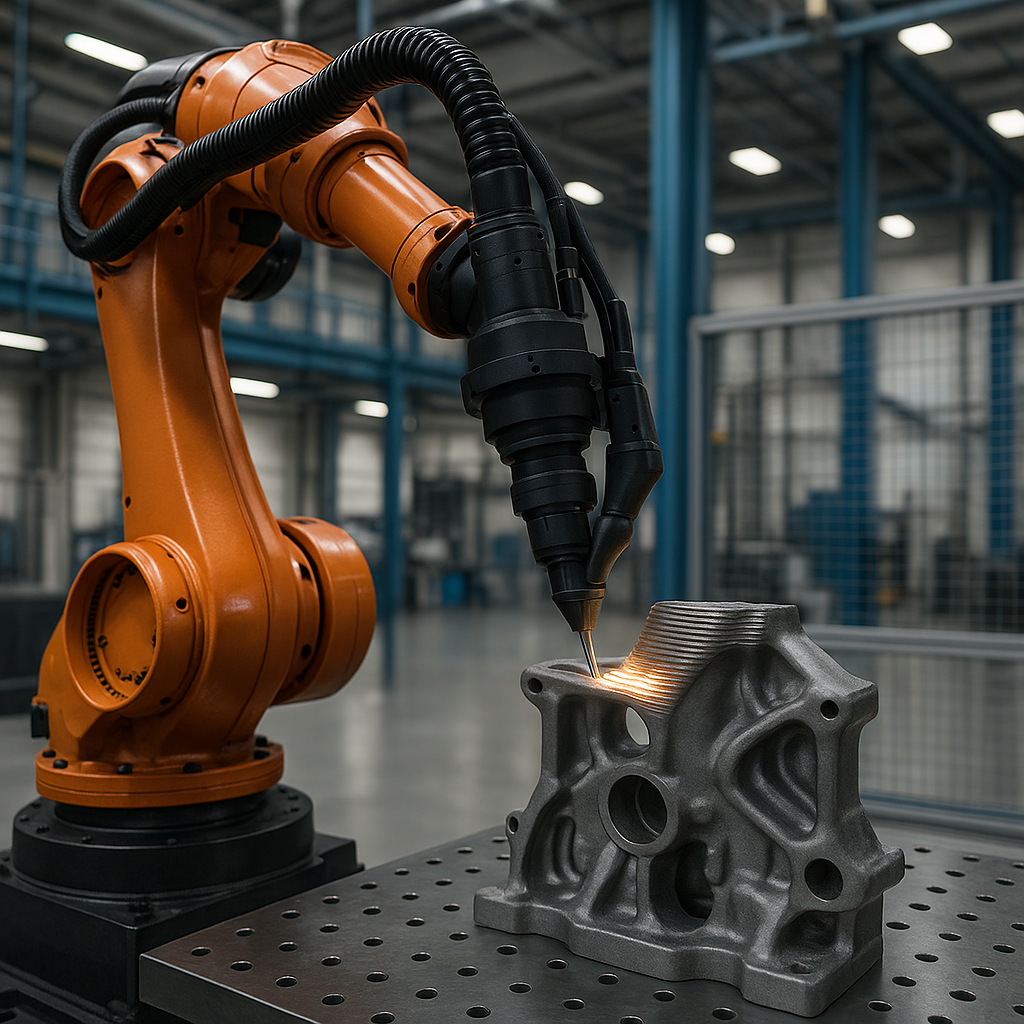
Sheffield Forgemasters has launched a groundbreaking hybrid manufacturing system that integrates robotic arm 3D printing with milling capabilities, aiming to transform the casting production process. As reported by The Manufacturer, this system represents a significant step forward in the application of robotic arm 3D printing within industrial casting workflows.
Why It Matters
The integration of additive and subtractive processes in a single robotic platform addresses longstanding challenges in casting production, such as precision, material waste, and lead time. By combining 3D printing with milling, Sheffield Forgemasters aims to produce complex, high-quality cast components with enhanced dimensional accuracy and surface finish. This hybrid approach leverages the flexibility of robotic arms to execute non-planar and multi-axis toolpaths, enabling more intricate geometries than traditional planar 3D printing allows.
Such innovation could disrupt conventional casting methods, reducing reliance on tooling and molds, accelerating prototyping, and enabling rapid design iterations. Moreover, this system aligns with broader industry trends toward digital manufacturing and automation, potentially setting new standards for efficiency and customization in heavy industry sectors.
Technical Context
Robotic arm 3D printing is a subset of non-planar and multi-axis additive manufacturing that uses articulated arms to deposit material along complex, curved surfaces rather than flat layers. This capability allows for improved mechanical properties, reduced support structures, and novel design freedoms. However, challenges have included controlling deposition accuracy, synchronizing multi-axis motions, and integrating post-processing steps.
Sheffield Forgemasters’ hybrid system appears to address these challenges by combining additive deposition with in-situ milling within the same robotic framework. This likely involves advanced motion control algorithms, real-time process monitoring, and precise calibration between the printing and milling tools. While exact technical specifications and material types used remain undisclosed, the approach suggests a move toward closed-loop manufacturing processes where additive and subtractive steps are seamlessly coordinated.
Near-term Prediction Model
Given the current announcement and the typical industrial adoption cycle, this hybrid system is likely in the pilot to early commercial stage. Sheffield Forgemasters is a well-established manufacturer with strong industrial expertise, which increases the likelihood of successful integration and scaling. Within 12 to 24 months, we can expect initial deployment in specialized casting projects, with gradual expansion as process parameters are refined and reliability improves.
Impact-wise, the system could significantly improve casting production efficiency and enable new design possibilities, scoring around 75 out of 100 on an impact scale. Confidence in this prediction is moderate (around 70) due to limited public technical details and the complexity of hybrid manufacturing integration.
What to Watch
- Technical disclosures or demonstrations detailing the robotic arm’s multi-axis control, material deposition methods, and milling integration.
- Case studies or pilot projects showcasing improvements in casting quality, production speed, and cost savings.
- Development of software tools enabling seamless transition between additive and subtractive toolpaths.
- Material compatibility and durability testing results to understand the range of alloys and composites supported.
- Expansion of hybrid manufacturing adoption beyond Sheffield Forgemasters to other heavy industry sectors.
In summary, Sheffield Forgemasters’ hybrid robotic arm 3D printing and milling system presents a promising advance in non-planar, multi-axis additive manufacturing for casting. While many technical details remain to be seen, this innovation could reshape how complex metal components are produced, merging the strengths of additive and subtractive processes into a unified, flexible manufacturing platform.