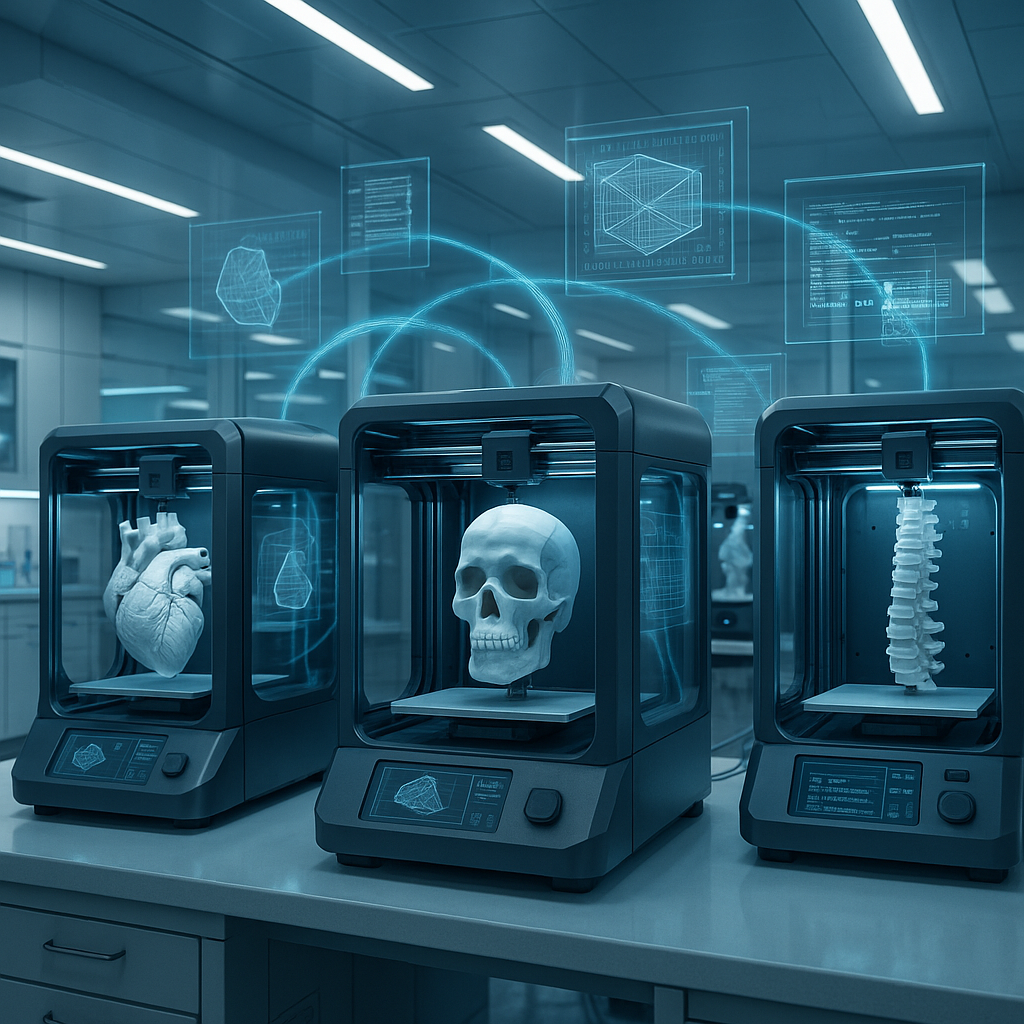
Recent developments in streamlined encoding for medical 3D printing files, as reported by BIOENGINEER.ORG, mark a significant step forward in the evolution of collaborative printing within medical 3D printing. This advancement focuses on more efficient file encoding methods that promise to optimize data exchange and interoperability between multiple 3D printing devices working in unison.
What Happened
The article highlights a newly developed streamlined encoding technique tailored specifically for medical 3D printing files. Although technical specifics remain sparse, the method appears to reduce file complexity and improve transmission efficiency, enabling faster and more reliable communication between devices. This innovation is particularly relevant for collaborative printing setups, where multiple printers or robotic arms work simultaneously on a single or coordinated print job.
Why It Matters
Medical 3D printing demands high precision, reproducibility, and safety compliance. Collaborative printing—where multiple printers or print heads operate in tandem—can drastically reduce production times for complex anatomical models, implants, or surgical guides. However, one of the bottlenecks has been the lack of a standardized, efficient file encoding system that can seamlessly orchestrate multiple devices without data loss or latency.
The streamlined encoding approach addresses this challenge by enabling faster and more reliable data sharing. This could accelerate the adoption of swarm and collaborative printing solutions in medical environments, allowing for distributed manufacturing of personalized medical devices and potentially improving patient outcomes through quicker turnaround times.
Technical Context
Traditional 3D printing file formats like STL or OBJ are often bulky and lack metadata critical for medical applications, such as material properties, printer calibration data, or quality control parameters. More advanced formats like AMF or 3MF attempt to incorporate these features but can still be inefficient for real-time collaborative environments.
The new encoding method likely involves data compression, error correction, and metadata integration optimized for medical applications. Such encoding would facilitate synchronization across multiple printing units, ensuring consistent layer-by-layer printing and quality assurance. While the exact algorithms and protocols remain undisclosed, the focus on streamlined data handling is aligned with the requirements of swarm printing systems, which rely on precise coordination and low-latency communication.
Near-term Prediction Model
Given the current state of research and the reported development, this streamlined encoding technique is probably in the pilot stage within specialized medical research labs or advanced manufacturing facilities. Over the next 12 to 24 months, we can expect pilot implementations in controlled environments, focusing on validating interoperability and reliability in multi-printer setups.
Commercial adoption may follow if these pilots demonstrate clear benefits in speed, accuracy, and workflow integration. Hospitals and medical device manufacturers with high-volume or complex 3D printing needs are likely early adopters, particularly those exploring collaborative printing to scale production.
What to Watch
- Publication of detailed technical specifications or open standards related to the new encoding method.
- Demonstrations or case studies showcasing multi-printer collaborative printing workflows enabled by this encoding.
- Integration of the encoding standard into existing 3D printing software platforms and slicers.
- Regulatory acceptance or guidance on file formats and data handling for medical 3D printing.
- Emergence of swarm printing hardware specifically designed to leverage streamlined encoding for synchronized operation.
While the full scope and technical details remain to be disclosed, this advancement signals a promising direction for collaborative and swarm 3D printing in medical applications. By focusing on data efficiency and interoperability, it lays foundational work for scaling complex multi-device printing scenarios that could transform personalized healthcare manufacturing.