
What Happened
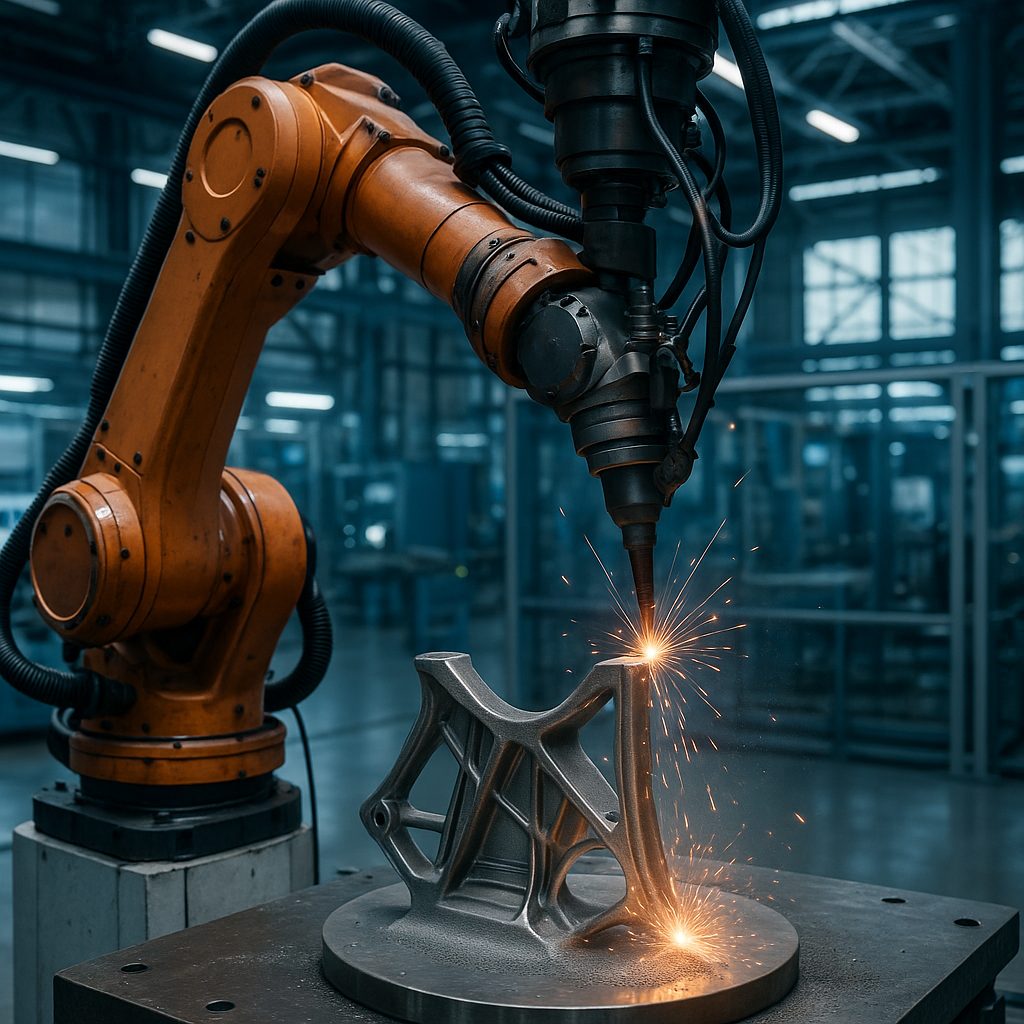
Airbus has recently advanced its aircraft manufacturing capabilities by integrating titanium 3D printing using robotic arm technology. This development, highlighted in a news release by Airbus, marks a significant step toward leveraging non-planar and multi-axis additive manufacturing to produce complex titanium components for aircraft. The use of robotic arms allows for more flexible, three-dimensional deposition paths beyond traditional planar layer-by-layer printing.
Why It Matters
This innovation is pivotal because titanium is a critical material in aerospace due to its strength-to-weight ratio and corrosion resistance. Traditional manufacturing methods for titanium parts often involve subtractive machining, which is costly, time-consuming, and generates significant material waste. Robotic arm 3D printing enables near-net-shape fabrication of titanium components with complex geometries, reducing waste and lead times.
Moreover, the ability to print on multi-axis paths allows for improved mechanical properties by aligning print trajectories with stress directions, a capability not possible with conventional planar 3D printing. This can lead to parts that are not only lighter but also stronger and more reliable, directly impacting aircraft performance and efficiency.
Technical Context
Robotic arm 3D printing refers to the use of multi-degree-of-freedom robotic manipulators equipped with metal deposition heads to fabricate parts in three dimensions without the constraints of a fixed planar build plate. This approach enables non-planar layer deposition, where material can be laid down along curved surfaces or complex angles, improving surface finish and structural integrity.
In the context of titanium printing, challenges include managing the high melting point of titanium, controlling thermal gradients to avoid residual stresses and distortion, and ensuring a stable inert atmosphere to prevent oxidation. Airbus’s implementation likely involves advanced laser-based powder bed fusion or directed energy deposition techniques adapted for robotic arms, although specific process details remain undisclosed.
The integration of multi-axis printing with titanium additive manufacturing also demands sophisticated software for path planning and process control to optimize print trajectories and maintain dimensional accuracy. The robotic arm platform offers flexibility to scale component size and complexity beyond conventional 3D printers.
Near-Term Prediction Model
Currently, Airbus’s robotic arm titanium 3D printing is at the pilot stage, focusing on qualifying parts for structural use and refining process parameters. Over the next 12 to 24 months, broader adoption within aerospace manufacturing is expected as certification processes mature and cost efficiencies improve.
The impact could be substantial, potentially scoring around 75 out of 100, due to the strategic importance of titanium components and the demonstrated benefits of robotic arm multi-axis printing. However, confidence is moderate (around 65 out of 100) because of remaining technical challenges, certification hurdles, and the need for supply chain adaptation.
What to Watch
- Further announcements from Airbus or partners detailing specific robotic arm printing technologies and process parameters.
- Certification milestones for titanium 3D printed parts produced via robotic arms, indicating readiness for critical structural applications.
- Advances in software for multi-axis path planning and real-time process monitoring to enhance print quality and repeatability.
- Development of hybrid manufacturing cells combining robotic arm additive and subtractive processes for titanium parts.
- Expansion of robotic arm 3D printing applications beyond aerospace into automotive, medical implants, and energy sectors.
While Airbus’s recent news confirms the growing importance of robotic arm 3D printing in titanium aircraft manufacturing, many technical and regulatory details remain undisclosed. Continued monitoring of this space will reveal how quickly this frontier additive manufacturing approach reshapes aerospace production.