
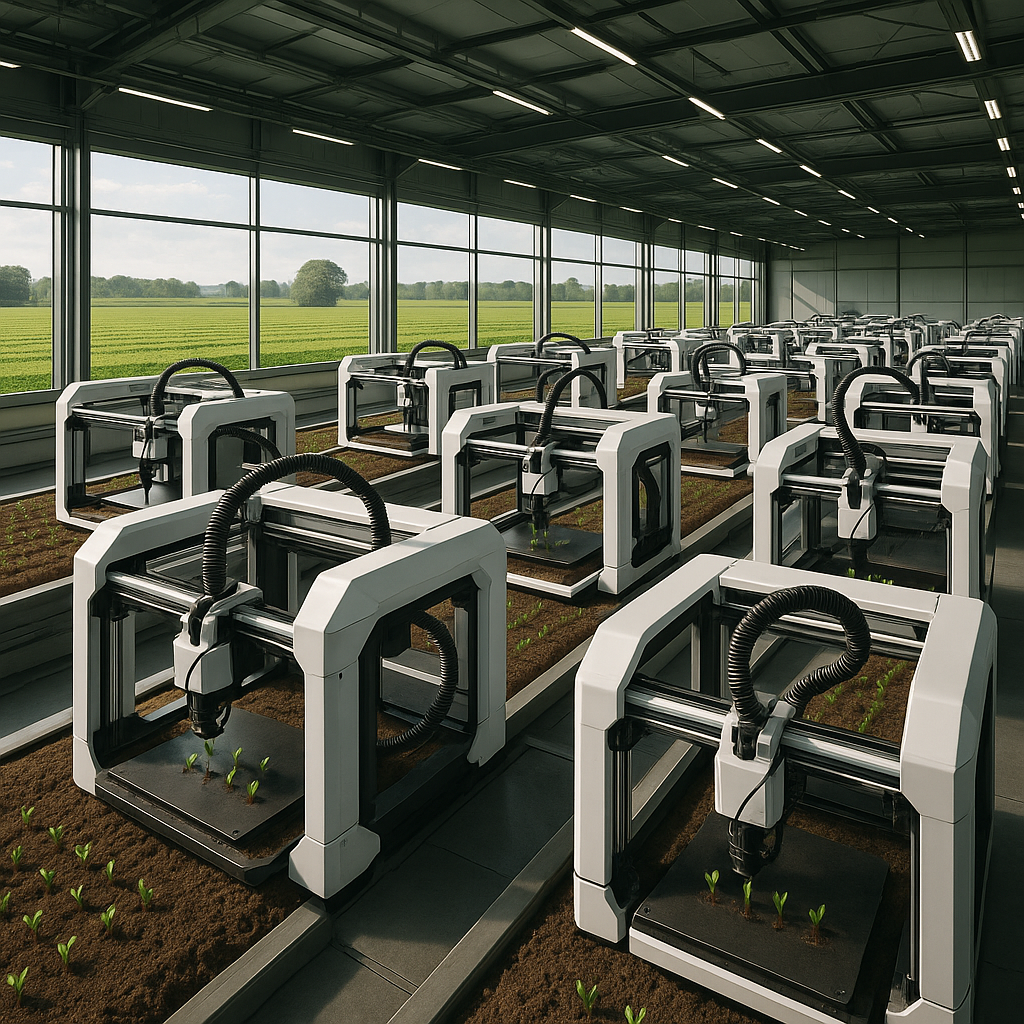
Recent developments in 3D printing and agriculture highlight the emerging role of swarm and collaborative printing technologies in automating print farms, particularly for agricultural applications. These advances are not only reshaping how additive manufacturing integrates with farming but also pushing the boundaries of print farm efficiency and scalability.
What Happened
A recent article by 3Dnatives sheds light on how 3D printing is expanding its footprint in agriculture, focusing on new frontiers that include the deployment of multiple 3D printers working collaboratively. This swarm approach enables simultaneous production of farming tools, replacement parts, and customized components, accelerating innovation cycles and reducing downtime in agricultural operations. While the article primarily discusses the agricultural impact, it implicitly underscores a broader shift towards print farm automation through collaborative 3D printing systems.
Why It Matters
The integration of swarm and collaborative printing into print farm automation holds transformative potential for agriculture and beyond. Traditional single-printer setups limit throughput and increase labor costs. By coordinating multiple printers to work in tandem, manufacturers can significantly boost productivity, reduce lead times, and achieve greater customization at scale. For agriculture, this means rapid fabrication of bespoke tools and components tailored to specific environmental conditions or crop types, enhancing operational resilience and sustainability.
Moreover, print farm automation driven by swarm technologies can reduce human intervention, lowering error rates and operational costs. This is critical in agriculture, where timely access to replacement parts or specialized equipment can directly affect crop yields and farm profitability.
Technical Context
Swarm and collaborative 3D printing involve networked printers communicating and coordinating tasks dynamically. Technologies enabling this include IoT integration, advanced scheduling algorithms, and real-time monitoring systems. These systems optimize print job distribution, manage printer maintenance proactively, and balance workloads to maximize uptime.
In the agricultural context, print farms may also incorporate diverse printer types and materials to fabricate a wide range of parts—from durable mechanical components to biodegradable seed planters. The challenge lies in harmonizing heterogeneous printer fleets and managing complex supply chains of raw materials.
Current setups often rely on centralized software platforms that monitor printer status, queue print jobs, and adjust parameters based on real-time feedback. However, fully autonomous swarm systems capable of self-healing and adaptive task reassignment remain under active research and pilot testing.
Near-term Prediction Model
Within the next 12 to 24 months, we anticipate pilot deployments of swarm-based print farm automation in specialized agricultural hubs and manufacturing clusters. Early adopters will focus on modular, scalable systems integrating diverse printers with cloud-based management platforms. These pilots will validate the efficiency gains and identify operational bottlenecks, such as network latency and material logistics.
Commercial maturity, where swarm printing becomes a standard for agricultural print farms, is expected within three to five years. During this phase, advances in AI-driven scheduling, autonomous maintenance, and cross-printer interoperability will drive broader adoption.
What to Watch
- Development of interoperable print farm management software: Platforms that support heterogeneous printer fleets and dynamic job allocation will be critical.
- Advances in autonomous printer maintenance: Self-diagnosing and repairing printers will reduce downtime and human labor.
- Material innovation: Biodegradable and multifunctional printing materials tailored for agriculture will expand application scope.
- Case studies from agricultural print farms: Real-world data on productivity gains and cost savings will influence adoption rates.
- Integration with farm IoT and robotics: Combining print farm automation with other digital farming technologies could create fully automated supply chains.
While the 3Dnatives article highlights agriculture as a fertile ground for 3D printing innovation, much remains unknown about the scalability of swarm systems across different agricultural scales and geographies. Further research and pilot projects will be essential to unlock the full potential of print farm automation driven by collaborative 3D printing.