
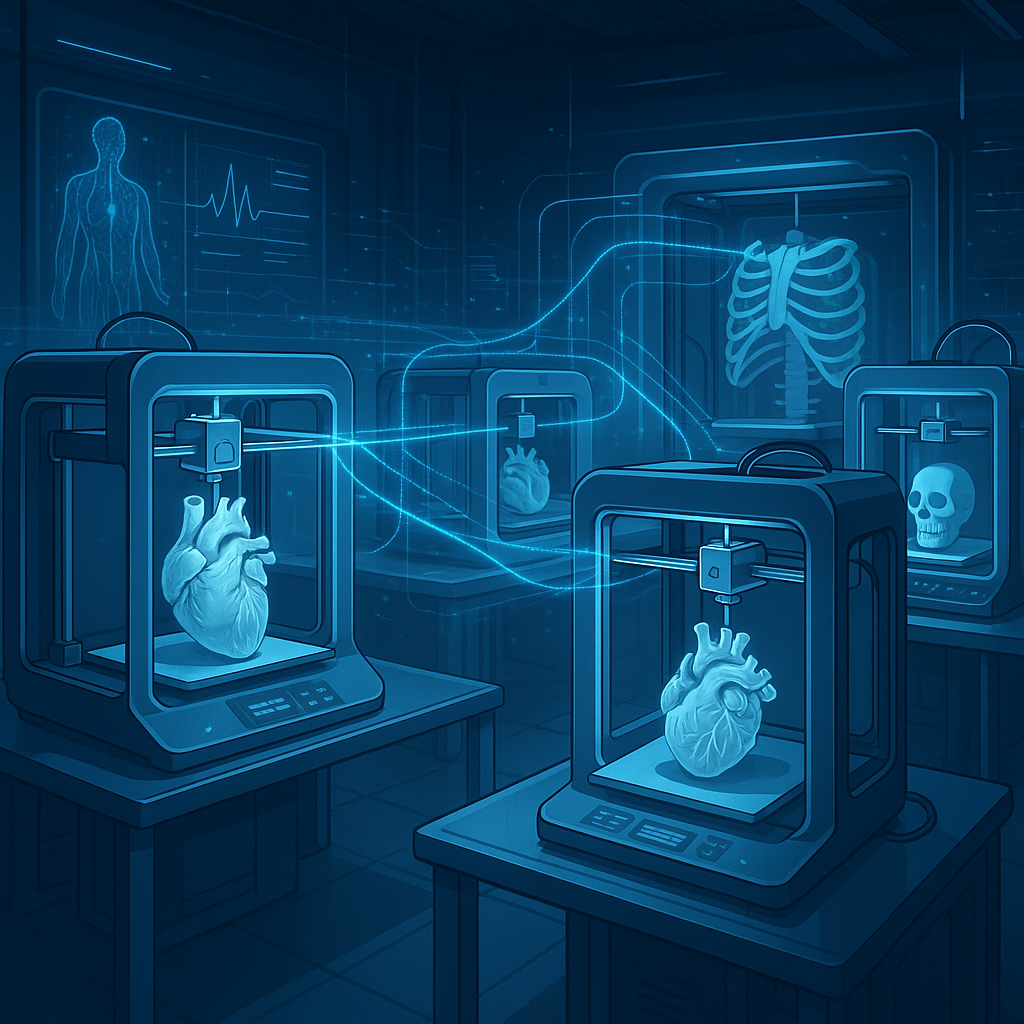
Recent developments in medical 3D printing have introduced streamlined encoding techniques for 3D printing files, as reported by Bioengineer.org. This innovation holds significant promise for the emerging field of collaborative printing, particularly in medical applications where precision, speed, and interoperability are critical.
What Happened
Bioengineer.org recently highlighted a breakthrough in encoding medical 3D printing files that streamlines how complex anatomical and biomaterial data is represented for additive manufacturing. While specific technical details remain limited in the public domain, this approach appears to optimize file structures to facilitate faster and more reliable data transfer and interpretation by 3D printers.
Why It Matters
In medical 3D printing, file complexity and size often become bottlenecks, especially when multiple printers or print nodes collaborate on a single project. Streamlined encoding can reduce latency and errors in file handling, enabling smoother collaborative printing workflows. This is particularly relevant as swarm and collaborative printing methods gain traction, where multiple printers work in concert to produce parts simultaneously or in sequence.
Improved file encoding can also enhance interoperability across different printer platforms and software ecosystems, a current challenge in medical additive manufacturing. This could accelerate the adoption of collaborative printing in clinical settings, where timely production of patient-specific implants, prosthetics, or surgical guides is vital.
Technical Context
Medical 3D printing files often include volumetric data, multi-material instructions, and metadata about biocompatibility and sterilization requirements. Traditional file formats like STL or OBJ lack the ability to fully encapsulate this complexity, leading to fragmented workflows. More advanced formats such as 3MF and AMF have been developed but still face challenges with size and encoding efficiency.
The new streamlined encoding method likely involves compression algorithms tailored to preserve critical medical data fidelity while minimizing file size. It may also incorporate standardized metadata schemas to ensure consistent interpretation by diverse printing hardware and software. This technical evolution supports the concept of collaborative printing by making data exchange between multiple print nodes more efficient and reliable.
Near-term Prediction Model
Given the current stage of this technology, it is reasonable to classify the streamlined encoding advancement as being in the Pilot phase, where initial implementations are tested in controlled environments. Over the next 12 to 18 months, we can expect pilot projects within hospital networks or specialized medical device manufacturers exploring collaborative printing setups using these optimized files.
The impact score is estimated around 65 out of 100, reflecting meaningful improvements in workflow efficiency and potential reductions in production time for complex medical parts. Confidence in this trajectory is moderate (around 70) due to limited publicly available technical details and the need for broader industry adoption.
What to Watch
- Publication of detailed technical specifications or open standards related to the streamlined encoding format.
- Case studies demonstrating multi-printer collaborative printing of medical devices using the new encoding approach.
- Integration of encoding methods with existing hospital information systems and 3D printing management software.
- Regulatory feedback or guidelines addressing data integrity and security for medical 3D printing files in collaborative environments.
- Expansion of this encoding technology beyond medical applications into other fields requiring swarm or collaborative printing.
While many details remain to be disclosed, the emergence of streamlined encoding for medical 3D printing files is a promising step toward unlocking the full potential of collaborative printing technologies in healthcare. Continued monitoring of pilot implementations and standardization efforts will be key to understanding its ultimate impact.