
What Happened
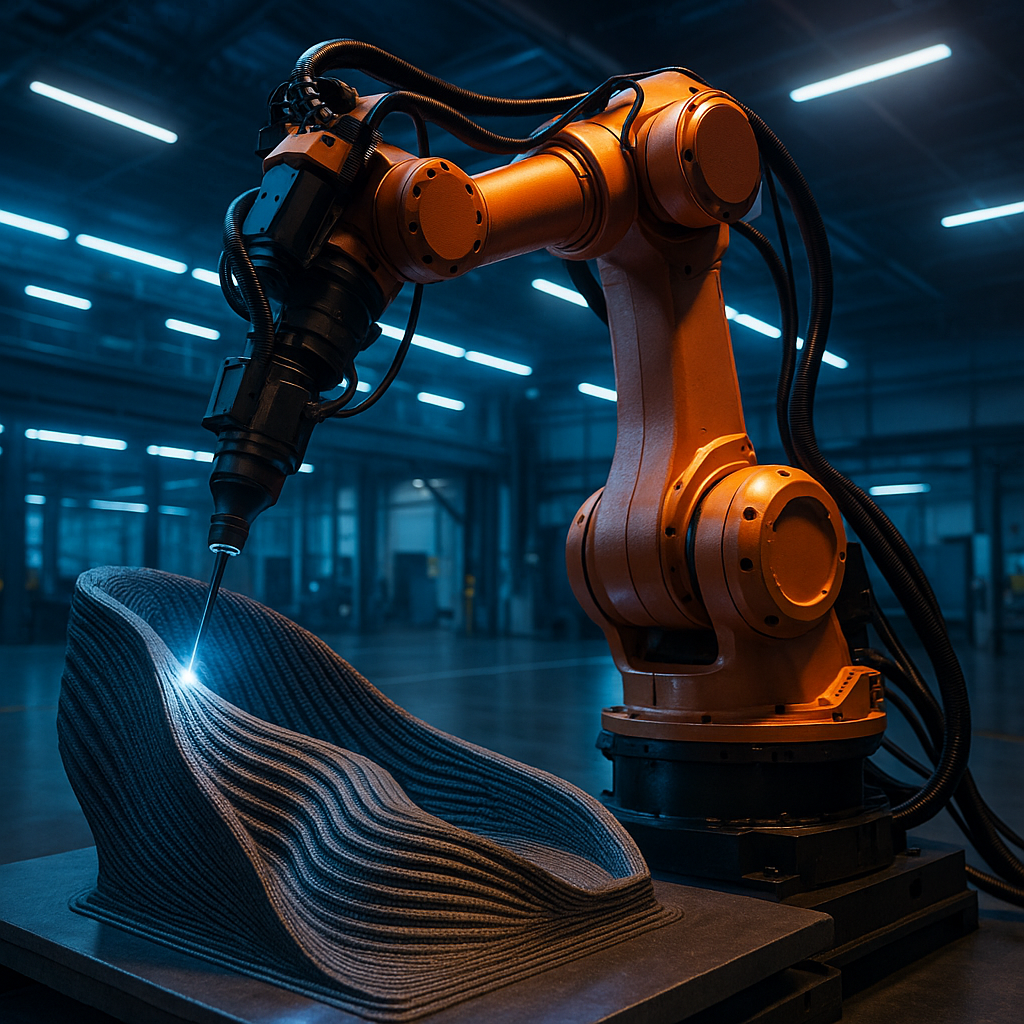
According to a recent report by People’s Daily Online published February 6, 2026, China is experiencing a rapid adoption of 3D printing technologies across production sectors and daily life. Notably, the integration of robotic arm 3D printing systems is gaining momentum, representing a significant shift towards non-planar and multi-axis additive manufacturing processes. This transition enables more complex geometries and improved manufacturing flexibility beyond traditional layer-by-layer planar printing.
Why It Matters
The accelerated deployment of robotic arm 3D printing in China signals a pivotal evolution in additive manufacturing capabilities. Robotic arms offer multi-axis movement—often 5 or 6 degrees of freedom—allowing printing on curved surfaces and complex shapes without the constraints of planar layering. This advancement unlocks new opportunities for industries such as aerospace, automotive, medical devices, and consumer products, where intricate designs and functional gradation are increasingly demanded.
Moreover, China’s broad adoption reflects a strategic push to embed advanced manufacturing technologies into both industrial production and everyday applications. This could enhance domestic manufacturing competitiveness, reduce reliance on imports of high-precision components, and accelerate innovation cycles. It also demonstrates a growing confidence in the scalability and reliability of robotic arm 3D printing systems.
Technical Context
Robotic arm 3D printing diverges from conventional gantry or delta printers by utilizing articulated arms capable of moving the print nozzle along complex trajectories in three-dimensional space. This non-planar printing approach reduces the need for support structures and post-processing, enabling smoother surface finishes and stronger mechanical properties due to continuous fiber deposition paths or optimized material orientation.
Multi-axis printing leverages kinematic capabilities to deposit material on non-flat substrates and perform in-situ repairs or modifications. Key challenges include precise motion control, real-time path planning, and integration of sensors for quality assurance. Advances in software algorithms, machine vision, and closed-loop feedback systems have recently matured enough to support commercial-scale robotic arm 3D printing.
While the People’s Daily Online article highlights rapid adoption, specific technical details such as the types of materials used, exact robotic platforms, or integration with other manufacturing processes remain unspecified. This gap underscores the need for further transparency and technical disclosures from Chinese industry leaders and research institutions.
Near-Term Prediction Model
In the next 12 to 24 months, we anticipate continued growth in pilot and commercial deployments of robotic arm 3D printing within China’s manufacturing ecosystem. Early adopters will likely focus on high-value, low-volume sectors such as aerospace components, customized medical implants, and tooling. The technology will progressively extend to consumer goods and automotive parts as costs decrease and process reliability improves.
Internationally, China’s advancements may accelerate competitive development elsewhere, prompting increased R&D investment globally in non-planar and multi-axis additive manufacturing. Collaborative efforts between robotics, materials science, and software engineering will be crucial to overcoming remaining hurdles such as print speed, material diversity, and certification standards.
What to Watch
- Emergence of standardized robotic arm 3D printing platforms and modular systems enabling rapid deployment.
- Breakthroughs in multi-material and composite printing compatible with robotic arms.
- Integration of AI-driven path planning and real-time quality control to enhance print precision.
- Policy incentives and industrial strategies from the Chinese government supporting advanced manufacturing adoption.
- Case studies demonstrating economic impact and scalability in industrial production lines.
- Intellectual property developments and international collaborations or tensions surrounding this technology.
Overall, the rapid adoption of robotic arm 3D printing in China represents a transformative step in additive manufacturing, pushing the boundaries of what can be produced with 3D printing technologies. Continued monitoring of technical progress, market penetration, and ecosystem development will be essential for stakeholders worldwide.