
What Happened
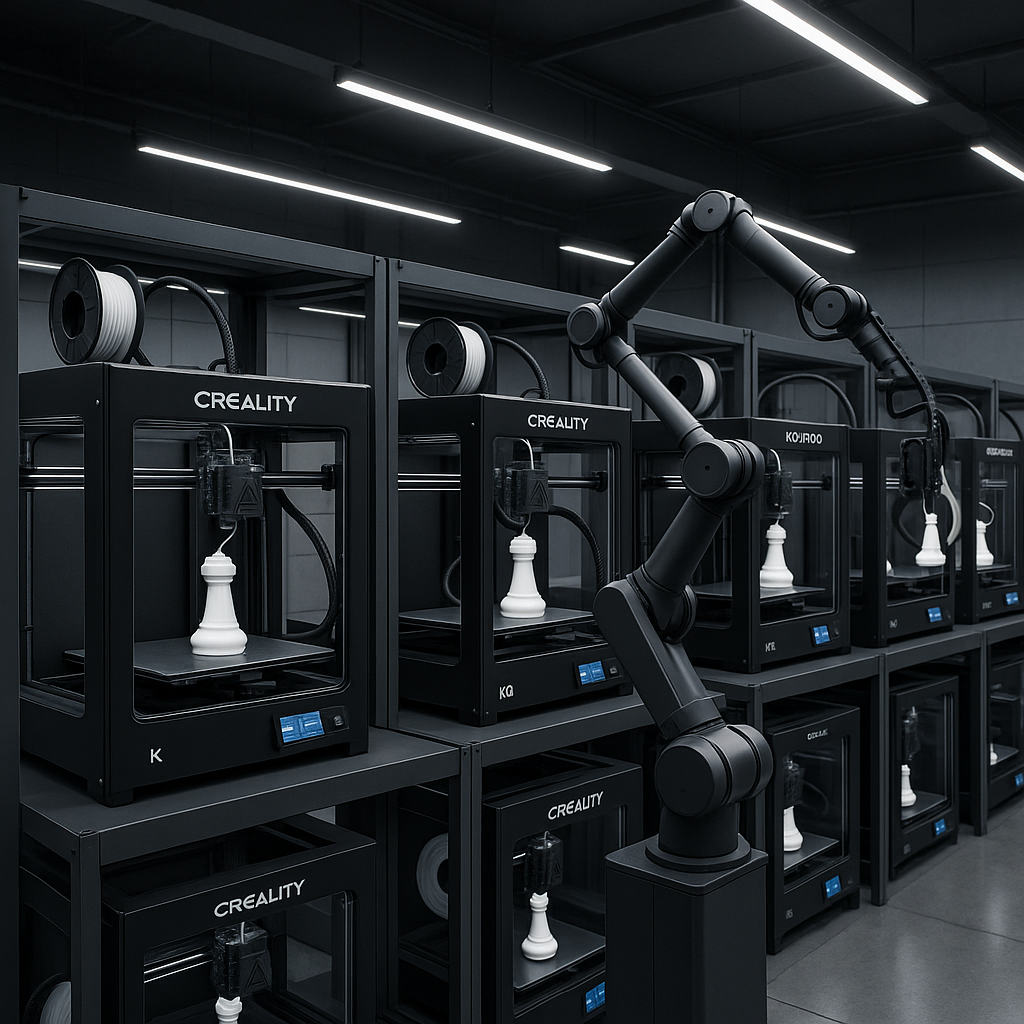
Creality recently unveiled the K2 and K2 Pro 3D printers, positioning them as potentially “print farm ready,” according to 3DPrint.com. These models aim to address the growing demand for automation and reliability in print farm environments, a critical factor for scaling 3D printing production. While exact technical specifications and integration details remain limited, the announcement highlights Creality’s focus on enhancing hardware suitable for collaborative and swarm printing setups.
Why It Matters
Print farm automation is a pivotal enabler for swarm and collaborative 3D printing technologies. As manufacturers and service providers seek to increase throughput and reduce manual intervention, printers designed with robust networking, remote monitoring, and standardized workflows become essential. Creality’s K2 series entering this space suggests a maturation of affordable, scalable hardware options for print farms, potentially lowering the barrier for smaller operations to adopt automated, multi-printer setups.
This development is significant because it aligns with industry trends toward distributed manufacturing and just-in-time production. By facilitating better print farm management, Creality could help accelerate adoption of swarm printing strategies, where multiple printers operate in concert to produce complex parts or large volumes efficiently.
Technical Context
While the announcement does not detail specific features, print farm readiness typically involves several technical components: reliable connectivity (Wi-Fi, Ethernet), advanced firmware supporting remote job queuing and monitoring, integration with print farm management software, and hardware features that minimize downtime (auto bed leveling, filament sensors, and fail-safe recovery). The K2 and K2 Pro likely incorporate some or all of these to be considered viable for print farms.
Swarm and collaborative printing extend beyond mere multi-printer setups; they involve orchestrated workflows where printers communicate and divide print jobs intelligently, sometimes even sharing print tasks for single complex parts. Currently, much of this coordination relies on third-party software platforms or custom solutions. The extent to which Creality’s K2 series supports such collaborative features natively or through ecosystem partnerships remains unknown.
Near-term Prediction Model
Given the current information, the Creality K2 and K2 Pro represent a commercially mature hardware platform targeted at small to medium print farms. Over the next 12 to 18 months, it is reasonable to predict incremental adoption of these models in automated farm environments, particularly among businesses seeking cost-effective scaling solutions.
However, the impact on true swarm printing—defined by dynamic collaboration and job distribution among multiple printers—may be limited initially. Significant software and firmware advancements are necessary to realize the full potential of swarm printing beyond parallel operation. Thus, the K2 series may serve as a foundational step toward broader swarm capabilities rather than a complete solution.
What to Watch
- Detailed technical specifications and firmware capabilities of the K2 and K2 Pro related to network management, remote monitoring, and error recovery.
- Partnerships or integrations with print farm management and swarm coordination software platforms.
- User adoption rates and feedback from early print farm deployments to assess reliability and ease of automation.
- Announcements from Creality or third parties about software updates enabling collaborative print job distribution or swarm intelligence.
- Competitive responses from other manufacturers targeting print farm automation and swarm printing markets.
In summary, Creality’s K2 and K2 Pro printers mark a noteworthy development in print farm automation hardware, potentially accelerating the adoption of swarm and collaborative 3D printing workflows. While many technical details remain to be disclosed, this move reflects the growing importance of scalable, automated printing solutions in the 3D printing industry.