
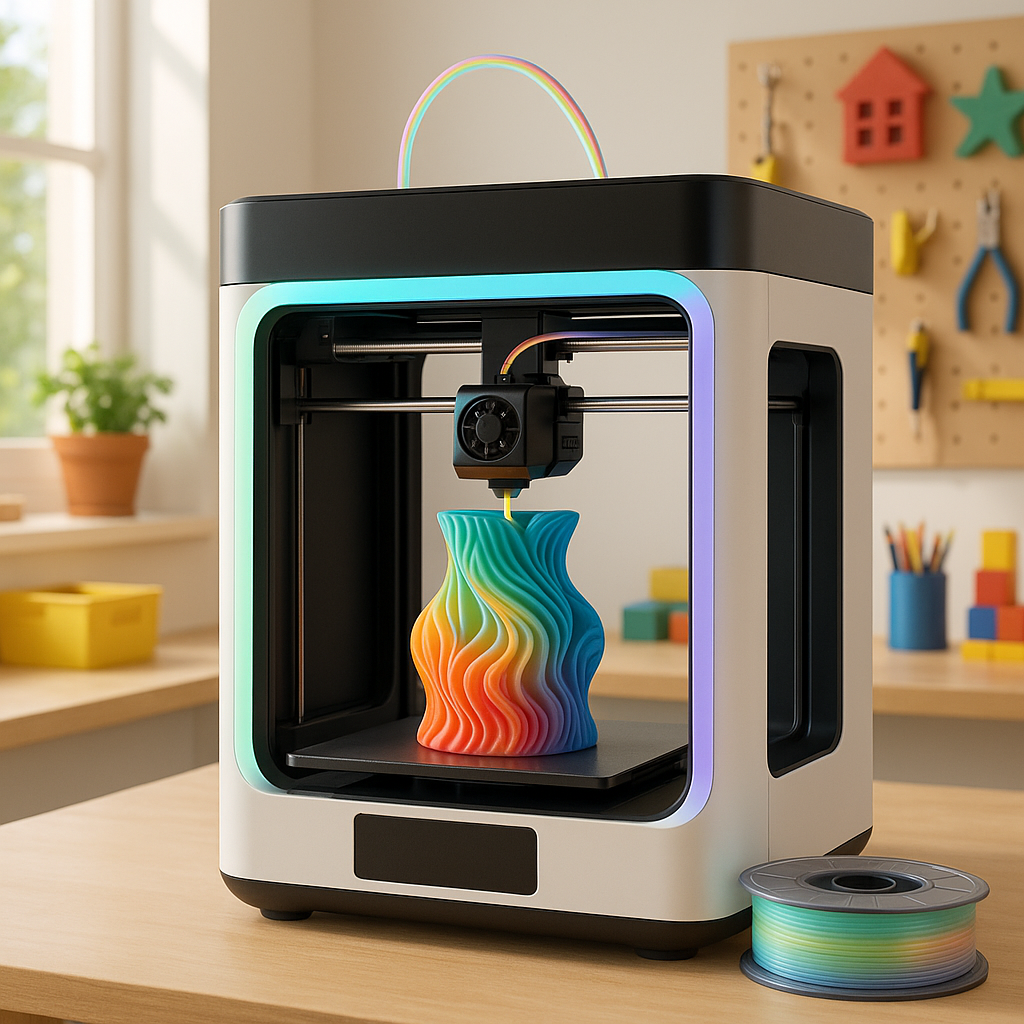
ELEGOO recently introduced the Centauri Carbon 2 Combo, a multicolor 3D printer designed with family-friendly usability in mind, as reported by Bolsamania. While the announcement focuses primarily on the printer’s multicolor capabilities and family-oriented design, it also signals an evolving landscape for 3D printing materials, particularly in the domain of smart filaments and bio-embedded materials.
What Happened
ELEGOO launched the Centauri Carbon 2 Combo, a new 3D printer model aimed at delivering multicolor printing with ease of use for a broad audience, including families and hobbyists. The device combines multiple printing heads or advanced filament handling to enable simultaneous printing with different colors, enhancing creative possibilities. Although specific technical details about the printer’s filament compatibility or embedded smart material functionalities were not disclosed in the announcement, the product’s positioning hints at growing accessibility for advanced material use cases.
Why It Matters
The introduction of a family-friendly multicolor 3D printer from a respected brand like ELEGOO is significant because it lowers the barrier to entry for more complex printing projects that can benefit from smart or bio-embedded materials. Smart filaments—materials that respond to environmental stimuli such as temperature, light, or electrical signals—are typically challenging to print reliably, especially in multicolor or multi-material setups. By making multicolor printing more accessible and user-friendly, ELEGOO potentially paves the way for broader experimentation and adoption of smart filaments in home, educational, and small-scale professional settings.
Moreover, the product launch reflects a broader industry trend toward integrating smarter materials into everyday 3D printing workflows without requiring extensive technical expertise. This democratization could accelerate innovation in fields like wearable technology, soft robotics, and biomedical devices, where bio-embedded and responsive materials are critical.
Technical Context
Multicolor 3D printing typically involves either multiple extruders or advanced filament mixing technology. The Centauri Carbon 2 Combo likely uses one of these approaches to enable simultaneous deposition of different colored filaments. The challenge with smart filaments lies in their often specialized printing requirements—such as precise temperature control, slower print speeds, or unique bed adhesion properties—that standard printers may not support.
Smart filaments include conductive materials, shape-memory polymers, thermochromic or photochromic filaments, and bio-based composites that can interact with their environment. Integrating these into multicolor prints adds complexity because each filament type may require distinct print parameters. A family-friendly multicolor printer that can handle these materials would need robust temperature control, filament detection, and possibly enhanced software to manage multi-material slicing and print sequences.
Currently, most smart filament applications remain at the R&D or pilot stage, with commercial adoption limited by cost, material availability, and printer compatibility. ELEGOO’s new printer does not explicitly claim smart filament compatibility, but its launch signals potential future developments in this space, especially if paired with evolving filament technologies.
Near-Term Prediction Model
In the next 12 to 24 months, we anticipate incremental improvements in multicolor and multi-material 3D printers that better support smart filaments. Companies like ELEGOO may introduce firmware and hardware upgrades to accommodate these specialized materials, driven by growing consumer interest and material innovation.
We predict a pilot-to-commercial transition for smart filament printing as manufacturers develop more reliable, easy-to-use printers that balance versatility with user-friendliness. The impact score for this technology’s influence on the consumer 3D printing market is moderate (around 60/100) given current material limitations but with high confidence (75/100) in steady progress.
What to Watch
- Announcements from ELEGOO or competitors about firmware updates or new printer models explicitly supporting smart or bio-embedded filaments.
- Emerging smart filament formulations that reduce printing complexity and broaden compatibility with existing 3D printers.
- Software advancements that simplify multi-material slicing and printing workflows for non-expert users.
- Collaborations between filament manufacturers and printer makers aimed at integrated smart material solutions.
- User community feedback and experimental projects leveraging the Centauri Carbon 2 Combo for smart filament applications.
In conclusion, while the Centauri Carbon 2 Combo’s launch primarily highlights multicolor printing accessibility, it also represents a subtle but meaningful step toward wider adoption of smart filaments in consumer 3D printing. Monitoring ELEGOO’s future product developments and the evolving smart filament ecosystem will be crucial to understanding how bio-embedded and responsive materials become mainstream in additive manufacturing.