
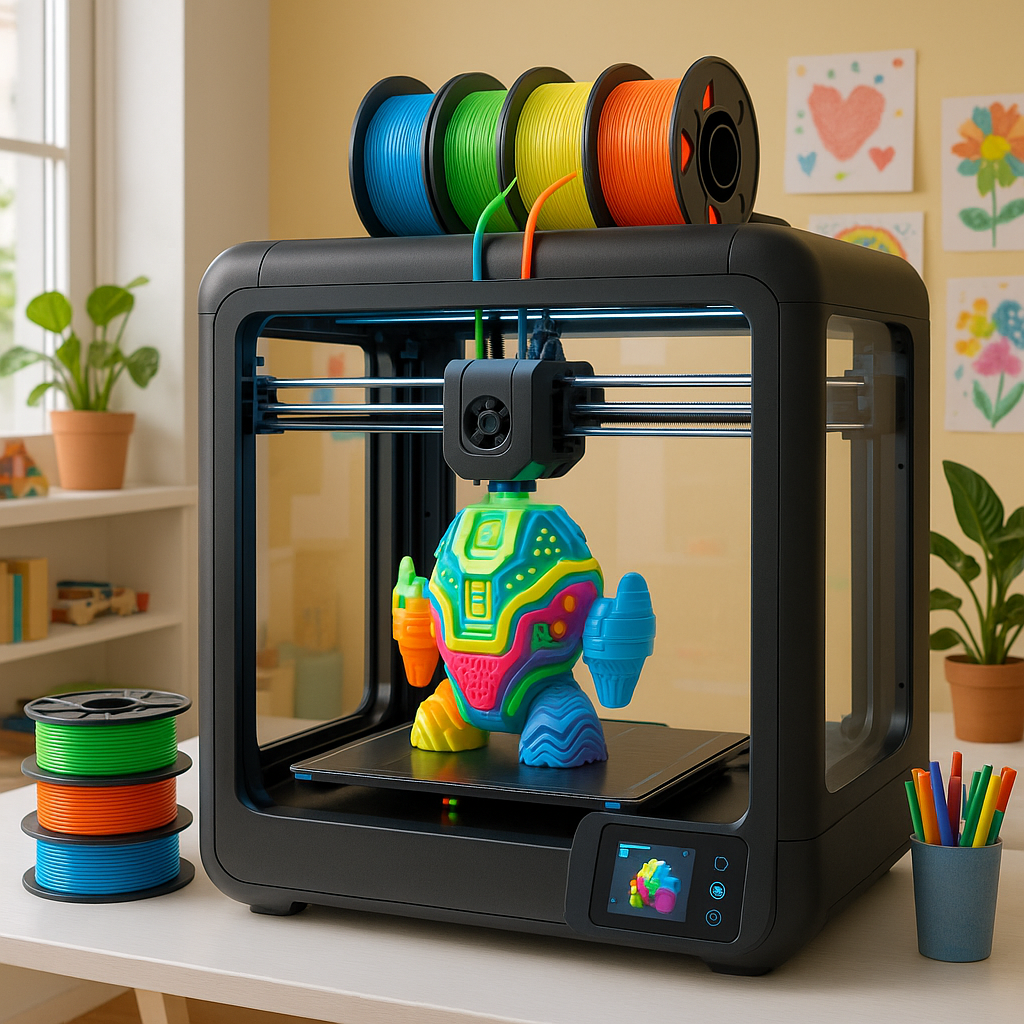
On January 26, 2026, ELEGOO announced the launch of its Centauri Carbon 2 Combo, a family-friendly multicolor 3D printer designed to broaden accessibility in the additive manufacturing space (acrofan.com).
What Happened
ELEGOO, a notable manufacturer in the desktop 3D printing market, introduced the Centauri Carbon 2 Combo, a multicolor 3D printer aimed at home users and families. While the announcement primarily focuses on the printer’s multicolor capabilities and user-friendly design, it implicitly touches on the growing demand for smart filament technologies that enable more complex, functional, and aesthetically diverse prints. Details about the printer’s specifications, filament compatibility—especially with emerging smart filaments—and embedded bio-materials remain limited in the public announcement.
Why It Matters
The launch of the Centauri Carbon 2 Combo is significant because it reflects a broader industry trend toward integrating smart and bio-embedded materials into accessible 3D printing platforms. Smart filaments—materials embedded with sensors, conductive elements, or responsive polymers—are increasingly important for producing functional prototypes, wearable electronics, and bio-interactive devices. By targeting families and hobbyists, ELEGOO is potentially democratizing access to these advanced materials and multicolor printing, which traditionally required industrial-grade equipment.
This move could accelerate innovation in educational settings and small-scale manufacturing, where understanding and experimenting with smart materials can foster new applications. Moreover, the multicolor capability complements smart filament usage by allowing simultaneous printing of multiple material types or functional zones within a single object, enhancing design complexity and utility.
Technical Context
Smart filaments encompass a range of materials that react to environmental stimuli (temperature, light, moisture), conduct electricity, or incorporate biological elements for sensing or actuation. Examples include thermochromic filaments that change color with heat, conductive filaments used in embedded circuits, and bio-inks containing living cells or biomolecules for medical or environmental applications.
Multicolor 3D printers like the Centauri Carbon 2 Combo typically use multiple extruders or advanced mixing nozzles to deposit different filaments in precise patterns. This capability is crucial for smart filament applications because it allows combining structural, functional, and aesthetic materials in one print. However, challenges remain in filament compatibility, print quality, and software integration to fully leverage smart materials’ potential.
ELEGOO’s announcement does not specify which smart filaments are supported or whether the printer includes firmware optimizations for these advanced materials. The extent to which the Centauri Carbon 2 Combo can handle bio-embedded filaments or integrate sensor feedback during printing is currently unknown.
Near-term Prediction Model
Given the commercial launch of the Centauri Carbon 2 Combo, the maturity stage of this technology is best classified as Commercial, with a growing but still niche market adoption for smart filament applications in the consumer segment.
The time horizon for widespread adoption of smart filament printing in family-friendly devices is estimated at about 18 to 24 months, as printer manufacturers and filament developers improve compatibility, ease of use, and material diversity.
Impact score is moderate to high (65/100) because enabling multicolor and smart filament printing at the consumer level can stimulate new use cases and educational opportunities, although current technical and cost barriers limit mass adoption.
Confidence is moderate (70/100) due to limited publicly available technical data on the printer’s smart filament capabilities and the evolving nature of smart and bio-embedded materials.
What to Watch
- Detailed technical specifications and user feedback on the Centauri Carbon 2 Combo’s compatibility with various smart filaments, including conductive, thermochromic, and bio-inks.
- Software and firmware updates from ELEGOO that enable or optimize printing with smart and bio-embedded materials.
- Collaborations or partnerships between ELEGOO and smart filament manufacturers to bundle materials and printers for educational or hobbyist markets.
- Emerging standards or protocols for embedding sensors and bio-elements in consumer-grade 3D prints to ensure reliability and safety.
- Competitive responses from other 3D printer manufacturers targeting family-friendly multicolor and smart filament printing.
In conclusion, while ELEGOO’s Centauri Carbon 2 Combo primarily markets itself as a family-friendly multicolor 3D printer, it represents a meaningful step toward integrating smart filament technology into accessible desktop 3D printing. The lack of detailed information on smart filament support suggests this is an early commercial offering, but its launch signals growing momentum in embedding intelligence and multi-functionality into everyday 3D printed objects.