
What Happened
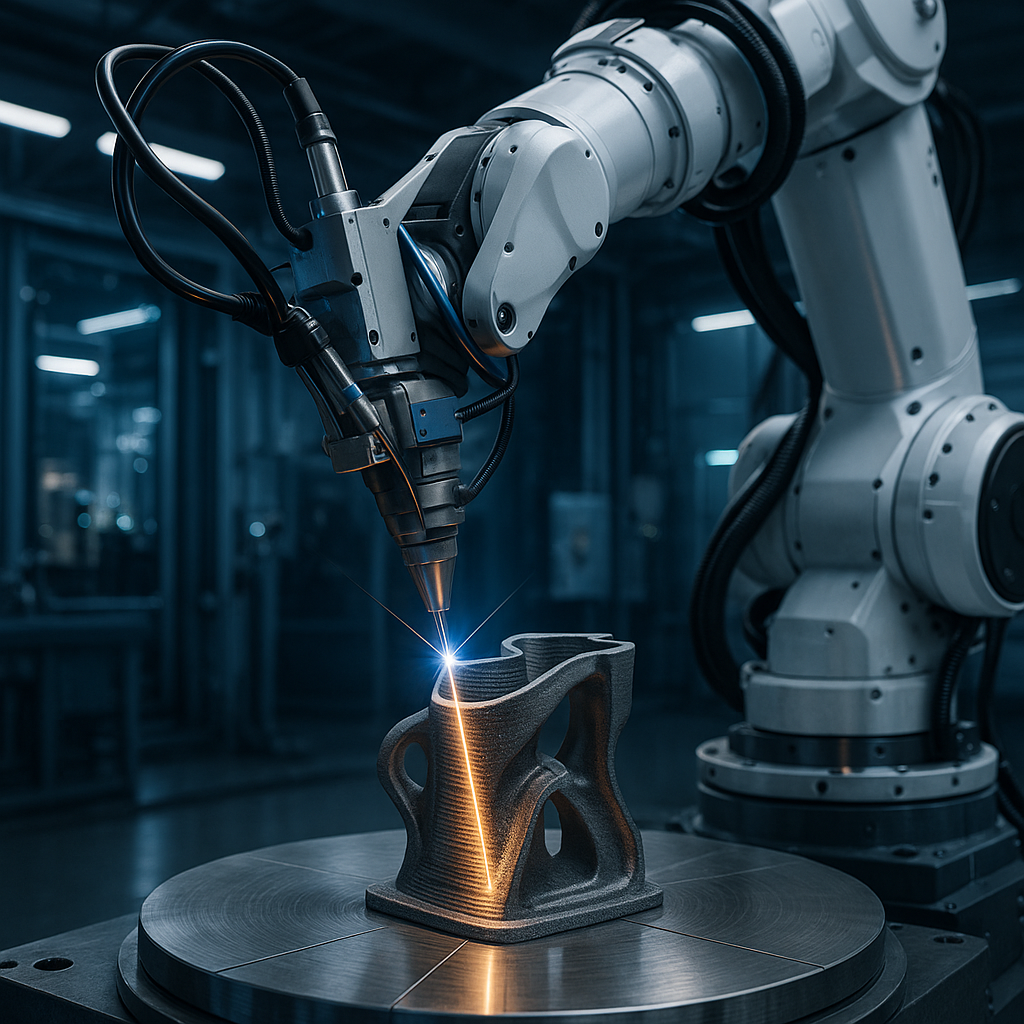
A research team at Hiroshima University has developed a novel hot-wire laser 3D printing method to fabricate industrial-grade tungsten carbide-cobalt (WC-Co) components, as reported by VoxelMatters. This approach leverages a combination of hot-wire technology and laser energy to deposit and fuse WC-Co powders, a notoriously difficult material for additive manufacturing, achieving industrial-grade quality. While the report does not explicitly state the use of robotic arms, the hot-wire laser method aligns with trends in multi-axis and non-planar 3D printing, often enabled by robotic arm platforms for complex geometries and enhanced process control.
Why It Matters
WC-Co is a key material for cutting tools and wear-resistant components due to its exceptional hardness and toughness. Traditional manufacturing of WC-Co parts involves energy-intensive sintering and machining processes that are costly and limited in geometric complexity. The ability to 3D print industrial-grade WC-Co components opens new frontiers for custom tooling, rapid prototyping, and repair applications with reduced lead times and material waste.
Furthermore, integrating hot-wire heating with laser energy potentially enhances deposition rates and microstructural control, addressing common challenges in metal additive manufacturing such as cracking, porosity, and residual stresses. This development signals progress toward industrial-scale, multi-axis robotic arm 3D printing systems capable of processing advanced materials beyond the usual metal powders.
Technical Context
Non-planar and multi-axis 3D printing methods enable deposition on curved surfaces and complex orientations, surpassing the limitations of traditional layer-by-layer planar printing. Robotic arms are frequently employed to provide six or more degrees of freedom, allowing dynamic toolpaths that improve surface finish, mechanical properties, and support reduction.
The hot-wire laser method combines resistive heating of a wire feedstock with localized laser melting, synergizing the advantages of both heat sources. Resistive heating preheats the material, reducing the laser power needed and minimizing thermal gradients, which can mitigate cracking and distortion. This hybrid approach is particularly promising for refractory and hard metals like WC-Co, which are challenging due to their high melting points and brittleness.
While robotic arm 3D printing is a growing area, most industrial adoption has focused on polymers and simpler metal alloys. The Hiroshima University research represents a substantive step toward expanding the material palette for multi-axis, non-planar printing, potentially integrating with robotic arm platforms to exploit their flexibility fully.
Near-Term Prediction Model
This technology is currently in the R&D phase, with promising lab-scale demonstrations but unclear details on scalability and integration with robotic arm systems. Given the complexity of WC-Co processing and the novelty of the hot-wire laser hybrid approach, commercialization within 12 to 24 months is plausible for niche applications such as tooling inserts or repair patches.
Key performance factors to validate include repeatability, mechanical property consistency, and process speed. If successful, this could catalyze broader adoption of robotic arm 3D printing for industrial hard metals, leading to new manufacturing paradigms.
What to Watch
- Further publications or demonstrations showing integration of the hot-wire laser technique with multi-axis robotic arms.
- Industrial partnerships or pilot programs testing WC-Co components manufactured by this method in real-world applications.
- Advancements in in-situ monitoring and closed-loop control to ensure quality and reduce defects during multi-axis printing.
- Comparative studies on mechanical properties and microstructures between conventionally manufactured and hot-wire laser 3D printed WC-Co parts.
- Expansion of the hot-wire laser method to other difficult-to-print materials, signaling broader applicability.
In summary, Hiroshima University’s hot-wire laser 3D printing of industrial-grade WC-Co marks a significant advance in non-planar, multi-axis additive manufacturing. While still early-stage, this innovation aligns with the growing trend of robotic arm 3D printing pushing the boundaries of material complexity and geometric freedom.