
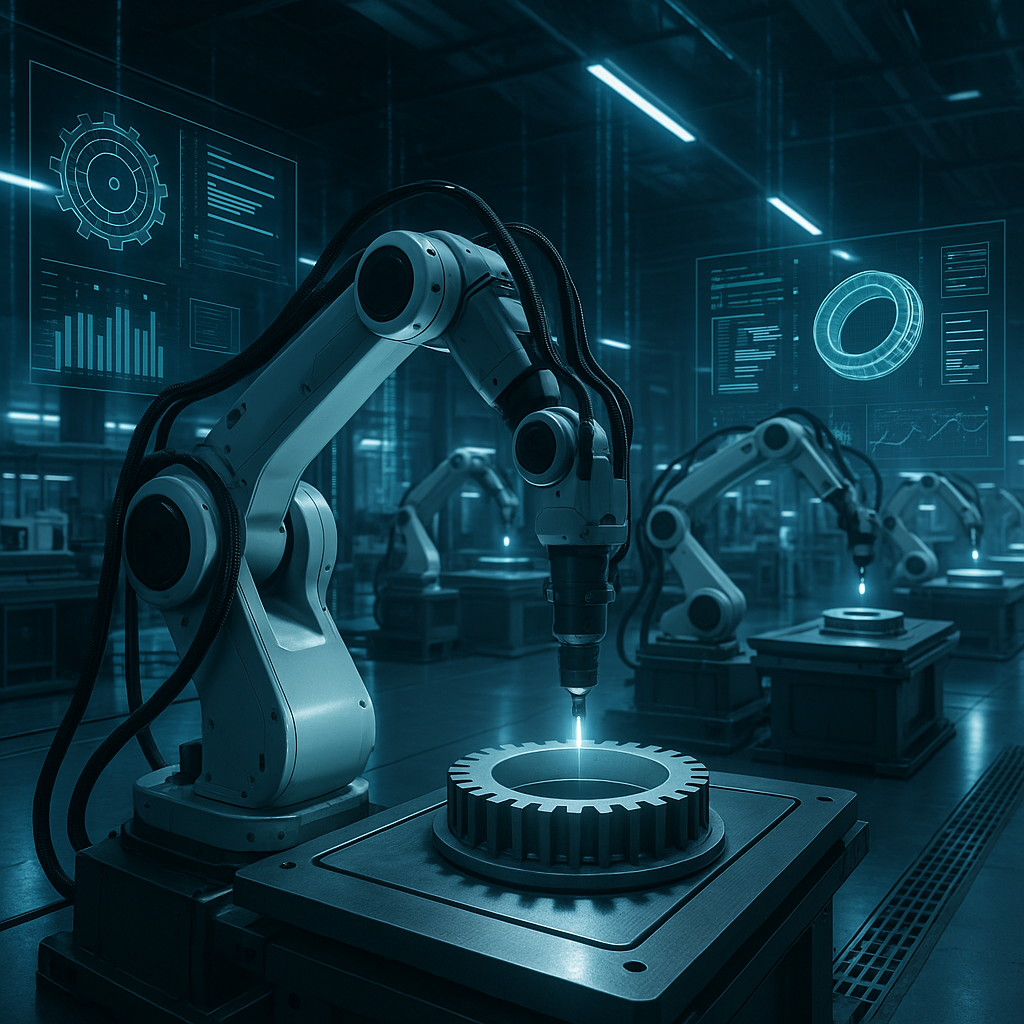
In a strategic move that could reshape supply chain and spare parts management, reported by 3D Printing Industry, Palantir has partnered with Divergent to advance AI-powered on-demand manufacturing.
This collaboration focuses on leveraging artificial intelligence to optimize the production of on-demand spares through advanced 3D printing technologies, effectively enabling a digital inventory model that can transform how companies manage parts availability and reduce physical stock requirements.
What Happened
Palantir, a leader in data analytics and AI software, has joined forces with Divergent, a company specializing in 3D printing and digital manufacturing platforms. Together, they aim to develop and deploy AI-driven manufacturing systems that can produce spare parts on demand rather than relying on traditional inventory stocking methods.
The partnership intends to integrate Palantir’s AI and data analytics capabilities with Divergent’s expertise in additive manufacturing to create a responsive, data-informed production pipeline. This pipeline would analyze demand patterns, supply chain constraints, and part criticality to dynamically produce spares as needed.
Why It Matters
The traditional approach to spare parts management involves maintaining large inventories, which can be costly, inefficient, and prone to obsolescence. By shifting to an on-demand manufacturing model powered by AI, companies can drastically reduce inventory costs, minimize waste, and improve service levels.
This is particularly critical for sectors with complex supply chains such as aerospace, automotive, and heavy machinery, where downtime due to unavailable parts can be extremely costly. AI-driven on-demand manufacturing allows for a more agile and resilient supply chain, better able to respond to unforeseen disruptions or demand spikes.
Moreover, this approach supports sustainability goals by reducing overproduction and enabling localized manufacturing, which decreases transportation emissions and lead times.
Technical Context
At the core of this partnership is the integration of Palantir’s advanced AI algorithms with Divergent’s digital manufacturing infrastructure. Palantir’s platform excels in aggregating and analyzing vast datasets from supply chains, production schedules, and usage patterns, generating predictive insights about when and where parts will be required.
Divergent contributes its proprietary 3D printing technologies and digital factory solutions capable of producing complex parts with high precision and repeatability. The combination facilitates a closed-loop system where AI forecasts demand, triggers production workflows, and manages quality control in real time.
While specific technical details of the integration remain undisclosed, the approach likely involves machine learning models trained on historical and real-time data, connected to manufacturing execution systems that can automatically schedule and execute print jobs.
Near-term Prediction Model
This AI-powered on-demand manufacturing system is currently at the pilot stage, with initial deployments expected within the next 12 to 18 months. Early implementations will likely focus on high-value, low-volume spares where the cost-benefit ratio of on-demand production is most favorable.
The impact score for this technology is estimated at 75 out of 100, reflecting its strong potential to disrupt traditional inventory models and enhance supply chain agility. Confidence in the model stands at 70, acknowledging uncertainties in scaling and integration complexity.
What to Watch
- Scalability of AI-Driven Manufacturing: Monitoring how effectively the AI models can scale across different industries and part complexities will be crucial.
- Integration with Existing Supply Chains: The ease with which this system can be adopted by companies with legacy infrastructure will determine its market penetration.
- Regulatory and Quality Assurance Challenges: Ensuring that on-demand printed parts meet stringent industry standards, especially in aerospace and automotive sectors.
- Cost Competitiveness: Tracking the total cost of ownership compared to traditional inventory and manufacturing methods.
- Expansion of Part Types: Watching how the technology evolves to handle a broader range of materials and components.
In summary, the Palantir-Divergent partnership represents a significant step toward realizing AI-powered on-demand manufacturing as a practical solution for digital inventory and spare parts management. While challenges remain, the convergence of AI and advanced 3D printing promises to unlock new efficiencies and resilience in supply chains worldwide.