
What Happened
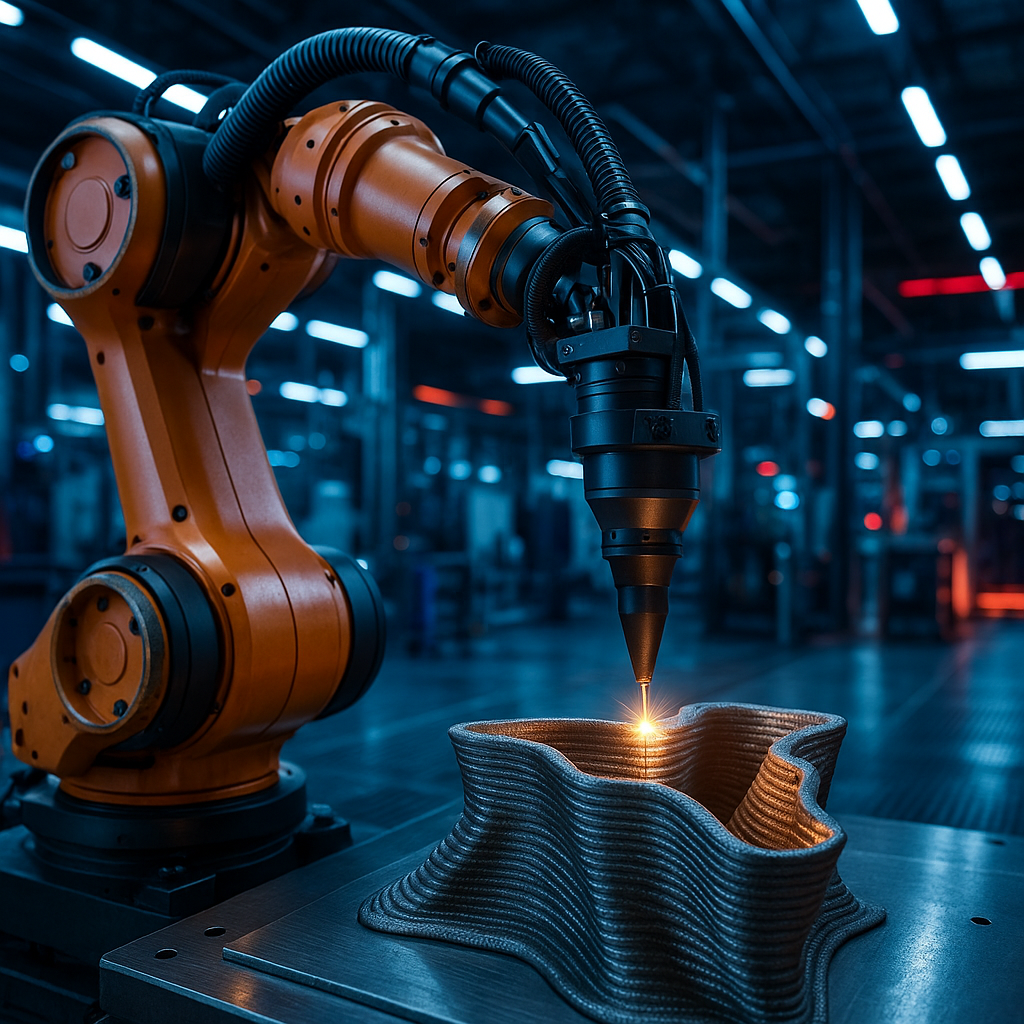
In a recent development spotlighted by EurekAlert!, MDF and Lincoln Electric have announced a partnership focused on advancing metal manufacturing through robotic arm 3D printing technology. This collaboration aims to integrate sophisticated robotic arms with additive manufacturing processes to improve precision, flexibility, and scalability in metal part production.
Why It Matters
The integration of robotic arms into metal 3D printing is a significant leap beyond traditional planar layer-by-layer methods. By enabling multi-axis and non-planar printing, this approach promises to reduce support structures, improve surface finish, and allow for complex geometries that were previously difficult or impossible to manufacture. This can drive down costs and lead times, while expanding design possibilities for industries such as aerospace, automotive, and heavy machinery.
Moreover, Lincoln Electric’s expertise in welding technology combined with MDF’s innovation in additive manufacturing creates a synergy that could accelerate the industrial adoption of robotic arm 3D printing. This is particularly relevant as manufacturers seek to enhance flexibility and customization without sacrificing quality or throughput.
Technical Context
Traditional metal additive manufacturing often relies on fixed, planar deposition techniques where each layer is printed flat and sequentially. Robotic arm 3D printing introduces multiple degrees of freedom, allowing the print head to move along complex paths and angles. This multi-axis capability enables non-planar layering, which can improve mechanical properties by aligning deposition paths with stress vectors and reduce the need for post-processing.
Lincoln Electric’s background in welding provides advanced control over heat input and material deposition, critical factors in ensuring metallurgical integrity and minimizing defects such as porosity or residual stress. MDF’s contribution likely includes software and hardware integration that enables precise coordination between the robotic arm’s kinematics and the additive manufacturing process.
While detailed technical specifications of the system remain undisclosed, the partnership suggests a focus on combining robust welding processes with agile robotic manipulation to create a versatile metal 3D printing platform.
Near-Term Prediction Model
Given the current stage of collaboration and the industrial players involved, this technology is likely in the pilot phase with targeted commercial deployments expected within 12 to 24 months. Early applications will probably focus on high-value, low-volume components where customization and complex geometries provide a competitive advantage.
As the technology matures, improvements in software for path planning and process monitoring, as well as hardware enhancements in robotic arm precision and deposition control, will broaden its applicability. The integration of real-time feedback systems to monitor melt pool characteristics and adjust parameters dynamically could further enhance part quality and process reliability.
What to Watch
- Announcements of pilot projects or case studies demonstrating the technology’s performance in real-world manufacturing environments.
- Development of advanced multi-axis slicing software tailored for robotic arm 3D printing to optimize non-planar toolpaths.
- Progress in integrating sensor feedback and AI-driven process control to ensure consistent metallurgical quality.
- Expansion of the partnership or new collaborations that bring complementary expertise or market access.
- Regulatory and certification milestones, especially for aerospace and medical applications where material integrity is critical.
While many details remain to be disclosed, the MDF and Lincoln Electric partnership represents a promising frontier in the evolution of metal additive manufacturing, leveraging robotic arm 3D printing to push the boundaries of design freedom and manufacturing efficiency.