
What Happened
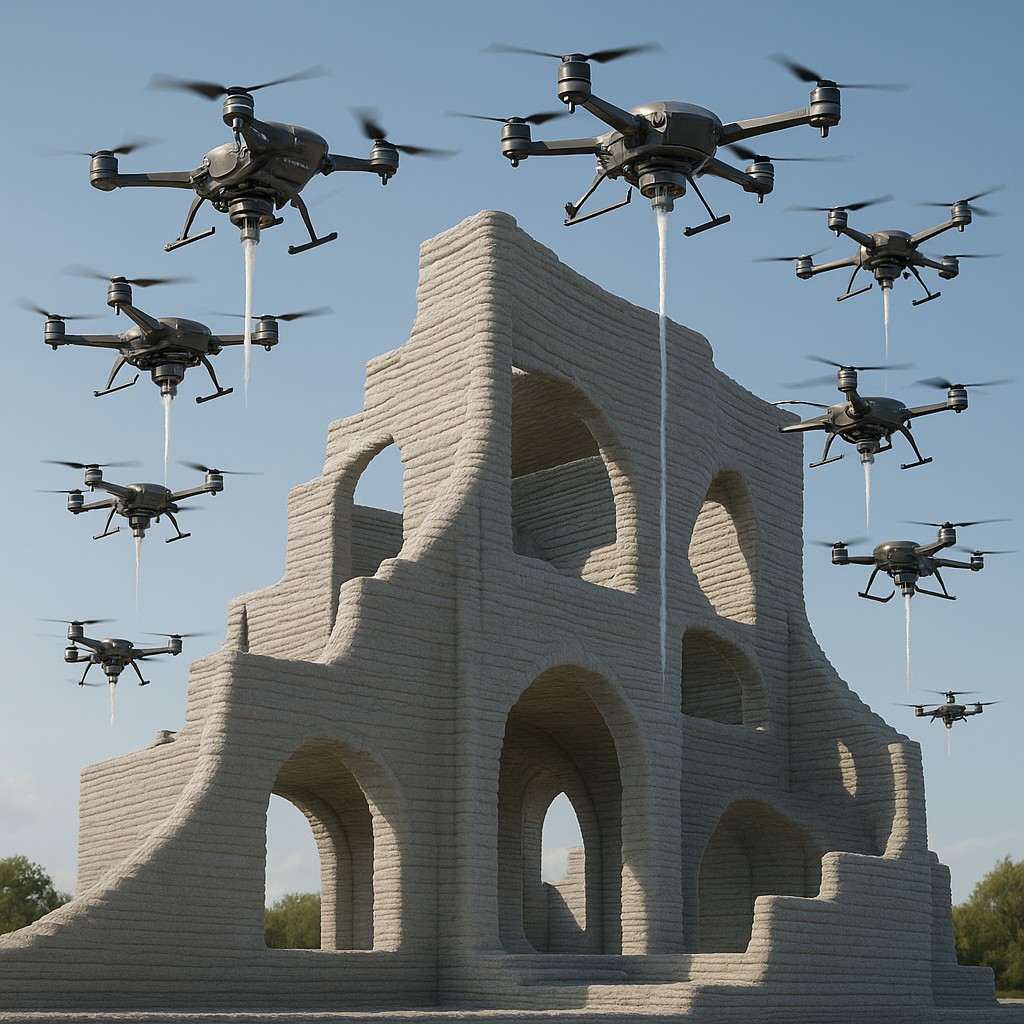
Researchers at the University of Pennsylvania have developed an innovative swarm of 3D printing drones designed to assist in manufacturing processes for building and repairing structures. This pioneering system leverages multiple autonomous drones working collaboratively to fabricate complex structures, potentially transforming traditional manufacturing and construction methodologies.
Why It Matters
The introduction of swarm 3D printing drones represents a significant leap forward in additive manufacturing by combining robotics, automation, and collaborative intelligence. Traditional 3D printing is typically limited by the size of the printer and the single-point fabrication process, which can be slow and constrained to smaller objects or require large, expensive machines for bigger projects.
Swarm drones, by contrast, can work simultaneously on different parts of a structure or coordinate to build large-scale objects in situ, such as walls, bridges, or repair patches for existing infrastructure. This distributed approach offers scalability, flexibility, and resilience—critical factors for applications ranging from disaster recovery to remote construction sites where deploying large equipment is impractical.
Technical Context
Swarm 3D printing combines principles from swarm robotics—where multiple robots coordinate to achieve a common goal—with additive manufacturing capabilities. Each drone is equipped with a 3D printing nozzle or extruder capable of depositing material, such as concrete, polymers, or composites, layer by layer.
The drones communicate wirelessly to synchronize their movements, manage task allocation, and avoid collisions. Advanced algorithms enable dynamic path planning and real-time adjustments to environmental conditions or printing errors. This coordination allows the swarm to build complex geometries faster than a single printer could.
However, many technical details remain unclear from the initial announcement, including the specific materials used, the maximum build volume achievable, the precision and resolution of the printed structures, and the autonomy level of the drones. Power supply and recharging logistics for continuous operations in the field also remain open questions.
Near-term Prediction Model
Given the current state of research and prototype development, this swarm 3D printing drone technology is likely in the advanced R&D to early pilot phase. Over the next 12 to 24 months, we can expect iterative improvements in drone coordination algorithms, material deposition techniques, and integration with construction workflows.
Initial pilot deployments may focus on small-scale repairs or modular structure assembly in controlled environments, such as university campuses or industrial test sites. Commercial adoption in large-scale construction or infrastructure repair may take 3 to 5 years, contingent on regulatory approvals, cost-effectiveness, and demonstrated reliability.
What to Watch
- Material Innovation: Development of printable materials optimized for drone extrusion, including fast-curing, durable composites suitable for structural applications.
- Autonomy and AI: Advances in AI-driven coordination and error correction to enable fully autonomous swarm operations without human intervention.
- Field Trials: Results from pilot projects demonstrating real-world applicability, especially in challenging environments like disaster zones or remote locations.
- Integration with Existing Construction: How swarm printing can complement or disrupt traditional construction methods and supply chains.
- Regulatory and Safety Standards: Emerging guidelines for drone operations in urban or populated areas, and standards for printed structural integrity.
In summary, the University of Pennsylvania’s swarm 3D printing drones mark a promising frontier in collaborative additive manufacturing. While many technical and operational challenges remain, the potential to revolutionize how structures are built and repaired—making processes faster, more flexible, and accessible—makes this an exciting area to follow closely.