
What Happened
A recent development in volumetric 3D printing technology, specifically tomographic printing, has been reported by 3DPrint.com. This new volumetric 3D printing approach leverages tomographic printing techniques to create complex structures in a rapid, non-layered fashion, opening promising avenues especially in the field of bioprinting.
Why It Matters
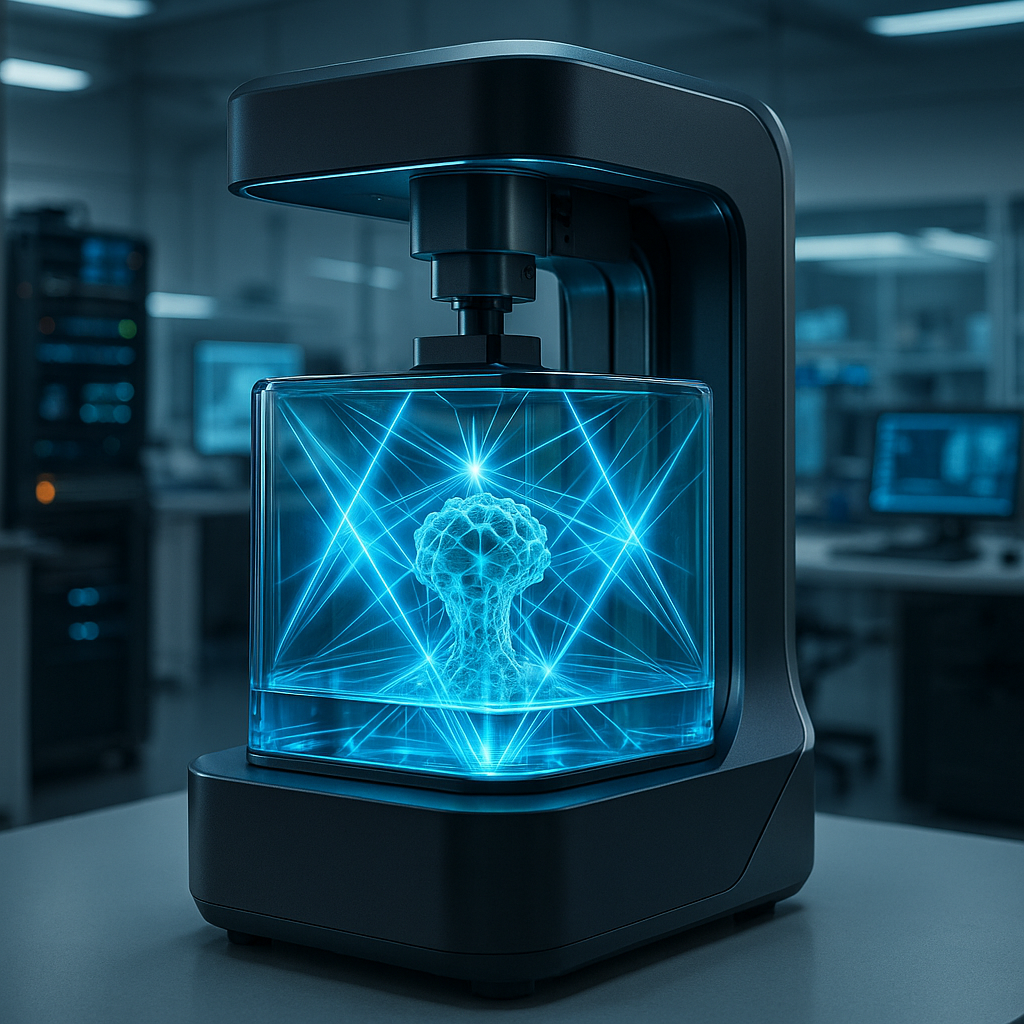
Traditional 3D printing methods build objects layer by layer, which can be time-consuming and often limits the complexity and viability of printed biological tissues. Tomographic volumetric printing breaks from this paradigm by simultaneously curing a full 3D volume using light projections from multiple angles, enabling the creation of intricate, cell-friendly structures within seconds. This rapid and high-resolution fabrication is a game changer for bioprinting, potentially accelerating tissue engineering, regenerative medicine, and personalized healthcare solutions.
Technical Context
Volumetric printing is a subset of additive manufacturing where the entire object is formed in a single step rather than through successive layering. Tomographic printing specifically uses a series of 2D light patterns projected from different angles around a rotating volume of photosensitive resin or bio-ink. These projections converge to polymerize the material precisely where the light intensity exceeds a threshold, resulting in a fully formed 3D object.
This technique contrasts with conventional stereolithography or extrusion-based bioprinting, which require sequential deposition or curing. The use of tomographic methods reduces mechanical stress on delicate biological components, preserves cell viability, and allows for printing of complex geometries such as vascular networks that are difficult to achieve with layer-by-layer approaches.
While the fundamental physics and optics involved are well established, adapting tomographic printing to biocompatible materials and living cells remains a significant challenge. The reported breakthrough from the source article highlights progress in overcoming these hurdles, although detailed technical parameters such as resolution limits, cell viability rates, and printing speeds are not fully disclosed.
Near-term Prediction Model
Based on current trends and the reported advances, tomographic volumetric printing is likely to remain in the pilot stage of maturity for the next 12 to 24 months. Early adopters in biomedical research and specialized manufacturing will begin integrating this technology into experimental workflows, particularly for fabricating complex tissue scaffolds and organoids.
Commercialization may follow as material formulations and printer hardware improve to meet regulatory and scalability requirements. The impact on the bioprinting field could be substantial, with an estimated impact score of around 75 out of 100, reflecting its potential to disrupt conventional methods but tempered by technical and regulatory challenges.
Confidence in this prediction is moderate (around 70 out of 100) due to the nascent state of the technology and the unknowns regarding long-term cell viability, reproducibility, and cost-effectiveness.
What to Watch
- Publication of detailed performance metrics including resolution, speed, and cellular viability data from academic or commercial research groups.
- Development of new biocompatible photopolymer resins optimized for tomographic curing.
- Integration of tomographic printing with other biofabrication technologies for hybrid manufacturing approaches.
- Regulatory approvals or clinical trial initiations using volumetrically printed biological constructs.
- Commercial announcements from 3D printing companies launching tomographic volumetric printers targeting biomedical markets.
- Collaborations between optics experts, biologists, and materials scientists to enhance printer design and bio-ink formulations.
In conclusion, tomographic volumetric printing represents a frontier in 3D printing technology with the potential to revolutionize bioprinting, enabling rapid, complex, and cell-friendly fabrication. Continued research and development will clarify its practical viability and pave the way for transformative applications in medicine and beyond.