
What Happened
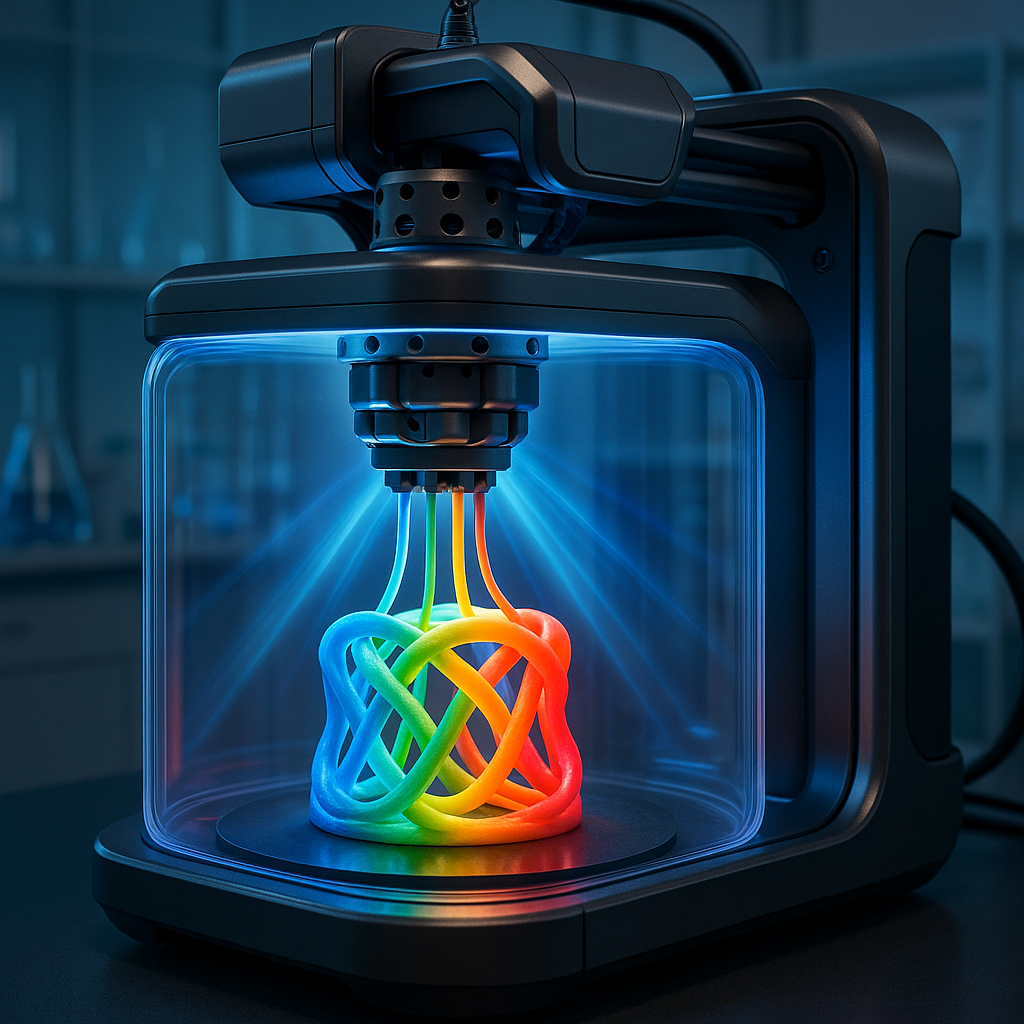
The University of Freiburg has engineered a novel single-step multi-material 3D printing technique that integrates embedded extrusion with volumetric curing, as reported by 3D Printing Industry on July 25, 2025. This breakthrough method enables the simultaneous deposition of multiple materials with embedded extrusion combined with volumetric curing, streamlining the fabrication of complex, multi-material objects in a single manufacturing step.
Why It Matters
This advancement is significant for the field of smart and bio-embedded materials, where the integration of diverse functional components within a single printed structure is often required. Traditional multi-material 3D printing typically involves sequential steps, which can introduce alignment errors, increase production time, and limit material combinations. By merging embedded extrusion and volumetric curing into a single-step process, the University of Freiburg’s approach promises higher precision, faster manufacturing cycles, and expanded material compatibility.
For bio-embedded applications, this means more sophisticated constructs can be produced that integrate biological elements or stimuli-responsive materials directly during printing. Such capabilities could accelerate developments in tissue engineering, wearable biosensors, and responsive medical devices.
Technical Context
Embedded extrusion involves depositing one or more materials within a supporting medium, which can stabilize soft or liquid materials during printing. Volumetric curing, on the other hand, uses light or other energy sources to cure or solidify materials throughout a volume simultaneously rather than layer-by-layer. Combining these two techniques allows for the rapid formation of complex geometries with multiple materials that may have different curing requirements or mechanical properties.
While volumetric 3D printing alone has been explored for speed and resolution, integrating embedded extrusion extends its versatility to multi-material structures, including soft and bio-compatible materials. The University of Freiburg’s innovation lies in coordinating these two processes in a synchronized manner, ensuring that the curing and material placement occur harmoniously to produce defect-free parts.
Details on the specific materials used, the types of bio-embedded components compatible with the process, or the scale of printed objects were not disclosed in the source article, leaving some questions about immediate applicability and limitations.
Near-Term Prediction Model
Given the R&D nature of this technology, it is likely to remain in the pilot stage for the next 12 to 24 months, during which further optimization, material testing, and application demonstrations will be pursued. The impact potential is high, rated around 75/100, due to its ability to simplify complex multi-material fabrication and enable new bio-embedded designs.
Confidence in the technology’s viability is moderate (around 65/100), as volumetric curing and embedded extrusion are established individually, but their integration poses technical challenges. Key risks include material compatibility issues, scalability constraints, and the complexity of synchronizing curing with extrusion without compromising part integrity.
What to Watch
- Publication of detailed technical data and performance metrics for the combined process.
- Demonstrations of bio-embedded constructs, especially involving living cells or stimuli-responsive materials.
- Development of commercial systems or partnerships to translate the technology into industrial or biomedical applications.
- Advances in compatible material formulations that can leverage embedded extrusion and volumetric curing simultaneously.
- Comparative studies assessing precision, speed, and mechanical properties versus existing multi-material 3D printing methods.
Overall, the University of Freiburg’s single-step multi-material 3D printing approach with embedded extrusion and volumetric curing represents a promising frontier in additive manufacturing, particularly for smart and bio-embedded material applications. Continued research and development will be critical to unlock its full potential and pave the way for new classes of multifunctional 3D printed devices.