
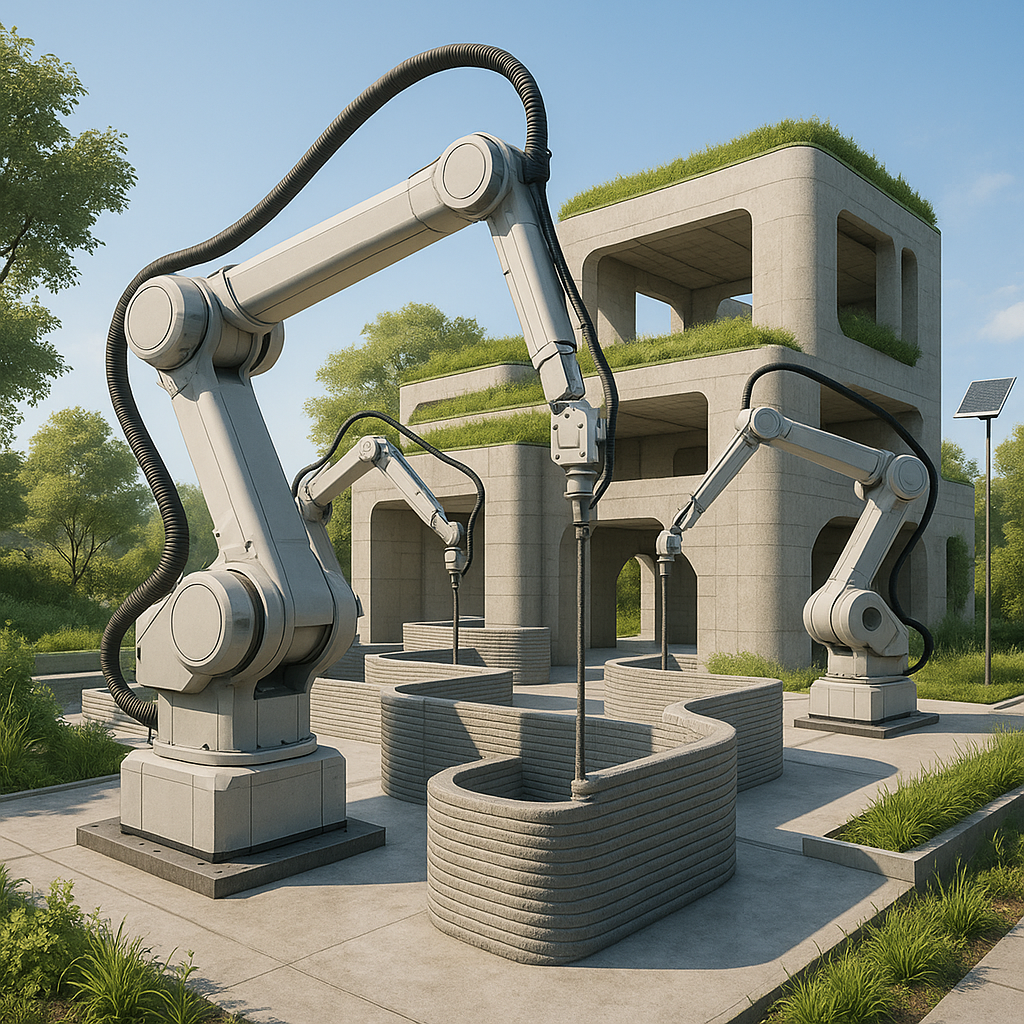
Researchers at the National University of Singapore (NUS) have made significant strides in sustainable 3D concrete printing tailored for the construction industry. This breakthrough leverages collaborative printing methods to enhance efficiency, reduce waste, and address pressing environmental concerns in construction.
What happened
The NUS team developed a novel approach to 3D concrete printing that integrates swarm or collaborative printing principles. While traditional 3D concrete printing typically involves a single large-scale printer depositing concrete layer by layer, the NUS researchers explored coordinated multi-unit printing systems. This method allows multiple print heads or robotic units to work in tandem, simultaneously depositing concrete on different sections of a structure.
The research focuses on optimizing the printing process to improve material usage and reduce the carbon footprint associated with concrete production. The team also addressed challenges such as synchronization, structural integrity during printing, and the adaptability of the printing system to complex architectural forms.
Why it matters
The construction sector is a major contributor to global CO2 emissions, primarily due to cement production. Innovations that enable sustainable construction methods are critical to meeting climate goals. By advancing collaborative 3D concrete printing, NUS is pushing the boundaries of how construction materials are deposited, potentially enabling faster build times, less material waste, and more intricate designs without traditional formwork.
Collaborative printing can also democratize construction by allowing modular, scalable printer arrays to be deployed on-site, reducing the need for massive machinery and heavy manual labor. This shift could lower costs and improve safety, particularly in challenging environments or disaster relief scenarios.
Technical context
3D concrete printing is an additive manufacturing process where a specially formulated concrete mix is extruded layer by layer to build structures. The mix must balance workability, setting time, and strength. NUS’s innovation lies in coordinating multiple print units to work simultaneously, a complex task involving real-time communication, precise positioning, and dynamic load management.
Collaborative printing requires advanced control algorithms to prevent collisions and ensure continuous structural integrity as different segments are printed in parallel. The NUS team likely employed sensor feedback and adaptive control systems to synchronize the print heads, although specific technical details such as hardware configurations and software frameworks remain undisclosed.
Moreover, the sustainability aspect involves optimizing the concrete mix with supplementary cementitious materials or recycled aggregates, reducing the embodied carbon footprint. The printing process can also minimize waste by precisely depositing only the necessary material.
Near-term prediction model
In the next 12 to 24 months, NUS’s collaborative 3D concrete printing technology is expected to progress from research and pilot demonstrations towards early commercial trials. Initial applications may focus on small to medium-scale construction elements such as walls, facade panels, or infrastructure components where modular printing units can be deployed effectively.
Adoption will depend on further validation of structural performance, regulatory approvals, and cost competitiveness versus traditional methods. Partnerships with construction firms and material suppliers will be crucial to scale the technology. Given the environmental urgency and increasing interest in automation, the impact score is moderate to high, reflecting significant potential but also technical and market challenges.
What to watch
- Detailed technical publications or patents from NUS clarifying the collaborative printing mechanisms and control systems.
- Pilot projects or demonstration builds deploying multiple coordinated print units in real construction sites.
- Development of sustainable concrete mixes tailored for multi-head printing and rapid setting.
- Regulatory acceptance and certification processes for 3D printed concrete structural elements.
- Collaborations between NUS and industry partners aiming to commercialize the technology.
While many aspects remain unknown—such as the exact configuration of the print units, software architecture, and scalability limits—the NUS research represents a promising frontier in swarm and collaborative 3D printing within construction. It exemplifies how additive manufacturing can evolve beyond single-device operation towards intelligent, distributed printing ecosystems that promote sustainability and efficiency.