
What Happened
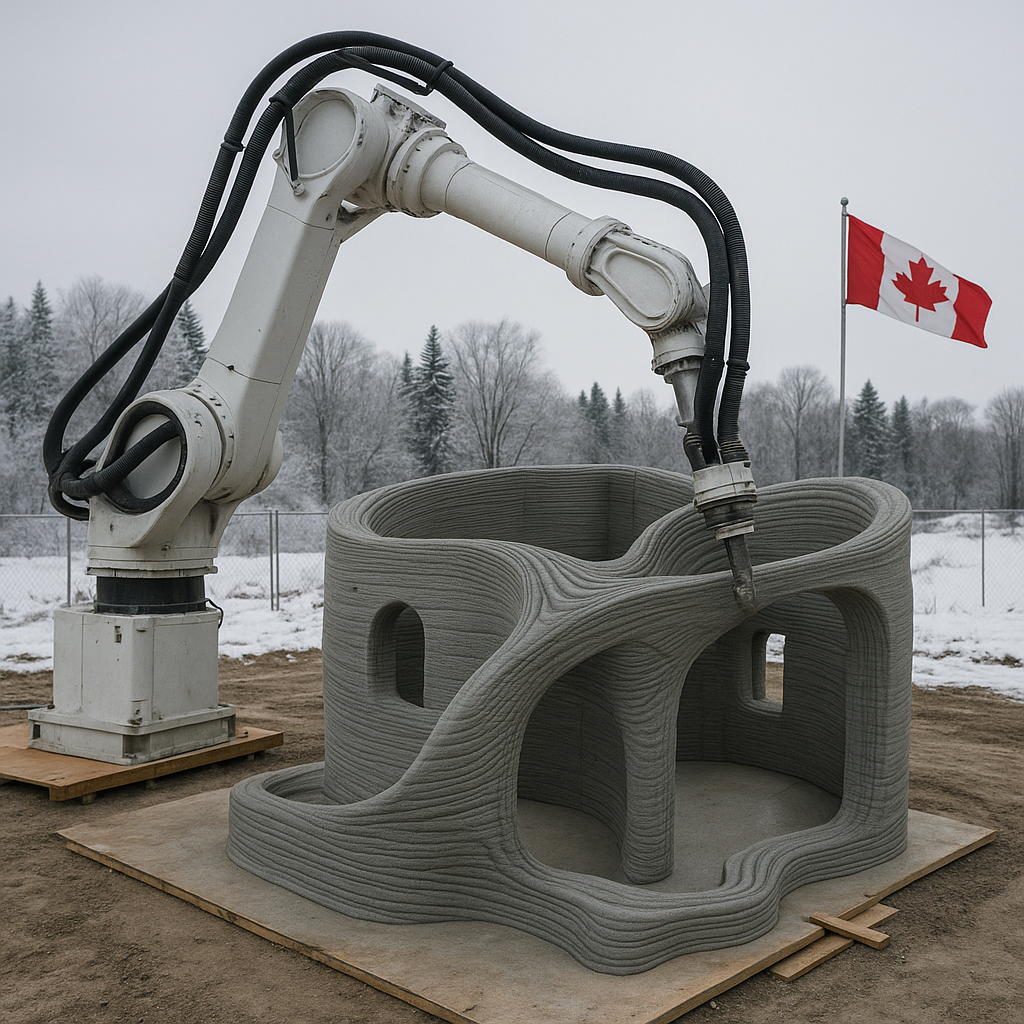
Recent developments in 3D printing technology are enabling a new wave of innovation in Canadian housing construction, as highlighted in a CBC report. Canadian companies and innovators are betting big on robotic arm 3D printing technologies to produce affordable, sustainable, and scalable housing solutions. This approach leverages non-planar and multi-axis printing techniques to build complex architectural forms layer by layer, directly on-site or in controlled environments.
Why It Matters
Canada faces significant housing shortages and rising construction costs, making traditional methods less viable for rapid, affordable development. Robotic arm 3D printing, with its ability to print on multiple axes and non-planar surfaces, offers transformative potential by reducing material waste, labor costs, and construction time. This technology could democratize access to housing, improve energy efficiency through optimized designs, and adapt quickly to diverse terrains and climates prevalent in Canada.
Moreover, multi-axis robotic printing allows for the creation of geometrically complex structures that were previously impossible or prohibitively expensive. This flexibility opens new architectural possibilities and enhances structural integrity by enabling continuous, curved layers rather than flat, stacked ones.
Technical Context
Traditional 3D printing in construction has often relied on planar, layer-by-layer deposition, which limits design complexity and can introduce weak points along layer boundaries. Robotic arm 3D printing utilizes articulated arms capable of moving in multiple axes (often six or more degrees of freedom), permitting non-planar deposition paths. This means the print head can follow curved surfaces, print overhangs without support, and orient extrusions to optimize mechanical properties.
The technology integrates advanced path planning algorithms and sensor feedback to maintain precision during complex movements. Materials used range from specialized concrete mixes to composite polymers designed for rapid curing and structural performance. These systems require robust software and hardware integration to synchronize motion control, material extrusion, and environmental conditions.
Despite its promise, challenges remain in scaling these systems for large-scale housing projects, ensuring consistent material quality, and meeting building codes and safety standards. The CBC article does not specify which Canadian companies or projects are leading these efforts, nor does it detail the exact robotic platforms or materials employed, indicating that some aspects remain under development or proprietary.
Near-Term Prediction Model
Within the next 12 to 24 months, pilot projects and small-scale commercial deployments of robotic arm 3D printed housing are expected to increase in Canada. Early adopters will likely focus on modular or accessory dwelling units (ADUs), affordable housing prototypes, and community shelters to validate cost savings and performance.
As the technology matures through iterative R&D and pilot phases, integration with local supply chains and compliance frameworks will improve. We anticipate gradual uptake in larger projects by 2028, contingent on demonstrated durability, regulatory acceptance, and economic viability.
Robotic arm 3D printing will also stimulate innovation in material science, especially in developing sustainable, locally sourced materials compatible with multi-axis printing. These advances will enhance environmental benefits and reduce carbon footprints associated with traditional construction.
What to Watch
- Regulatory Developments: Building codes and standards adapting to multi-axis 3D printed structures will be crucial for market adoption.
- Material Innovations: New concrete composites or bio-based materials optimized for robotic arm extrusion and curing.
- Software & Path Planning: Advances in AI-driven motion control and real-time sensor integration to improve print accuracy and speed.
- Pilot Project Outcomes: Data on structural performance, cost savings, and community acceptance from Canadian pilot housing projects.
- Collaborations: Partnerships between tech firms, construction companies, and government agencies to scale deployment.
While the CBC article sheds light on the growing interest in 3D printed housing in Canada, detailed technical and commercial data remain limited. Continued monitoring of these emerging projects and technological breakthroughs will be essential to understand the full impact of robotic arm 3D printing on the construction landscape.