
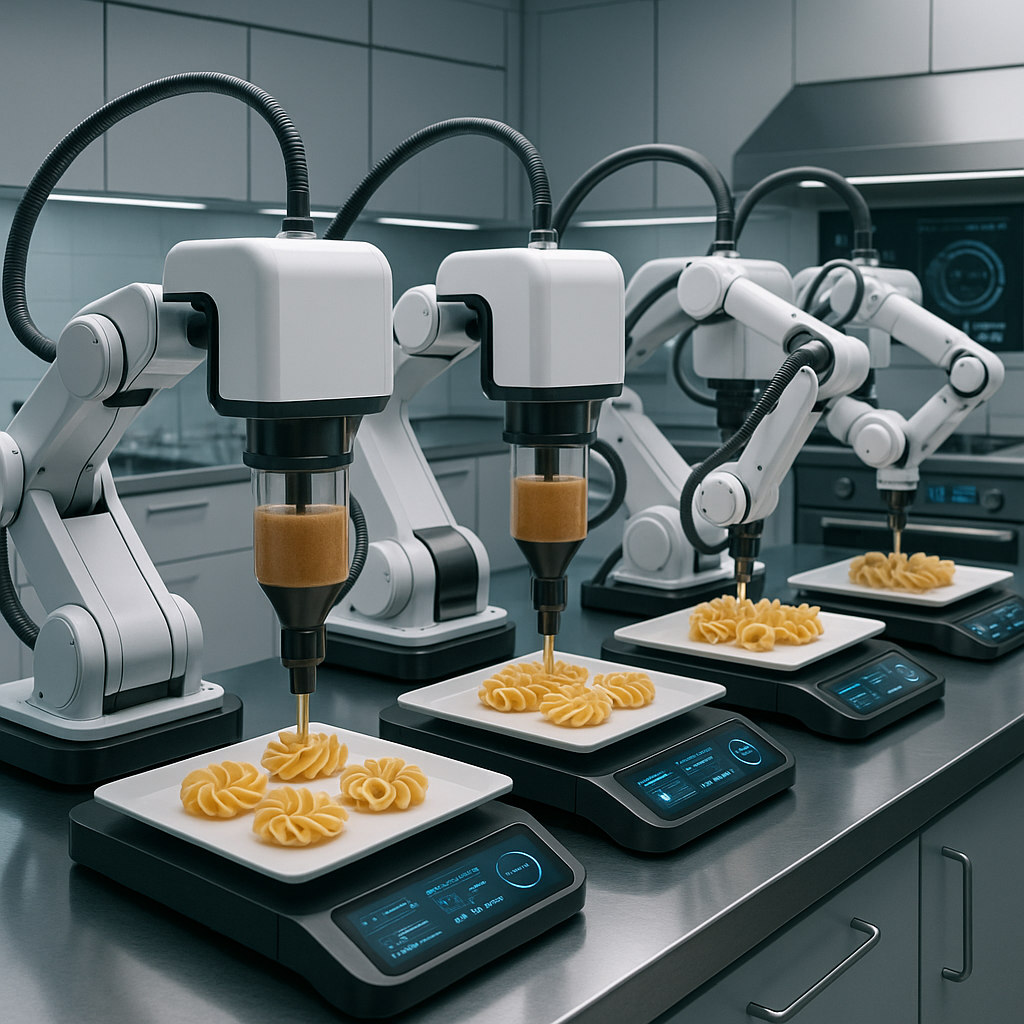
In a recent development reported by VoxelMatters, global pasta giant Barilla is expanding its food innovation portfolio by integrating 3D printing technologies. While the article highlights Barilla’s advancements, it also opens a broader conversation about the rising role of collaborative printing and swarm manufacturing in food production and other sectors.
What Happened
Barilla has begun leveraging 3D printing to innovate food design and production processes. Although specific technical details remain sparse, the initiative reportedly involves multiple 3D printers working in concert, which aligns with the concept of collaborative printing — where several machines or robotic units operate simultaneously to produce complex items efficiently. This approach can enable rapid prototyping, customization, and potentially scalable manufacturing of food products.
Why It Matters
Barilla’s adoption of 3D printing is more than a novelty; it exemplifies a shift toward decentralized, flexible manufacturing in the food industry. Collaborative printing, especially in swarm configurations, promises to overcome traditional production bottlenecks by distributing workload across multiple units. This can lead to faster production times, enhanced customization options for consumers, and reduced waste through precise material deposition.
Moreover, Barilla’s move signals growing confidence in the reliability and maturity of 3D printing technologies for commercial food applications. It also highlights the potential for cross-industry adoption of swarm and collaborative printing paradigms, which have been underexplored outside industrial prototyping and small-scale manufacturing.
Technical Context
Collaborative printing involves orchestrating multiple 3D printers or robotic arms to work simultaneously on a single or multiple parts of an object. In food printing, this requires synchronization of extrusion rates, temperature control, and material compatibility to ensure consistent quality. Swarm manufacturing extends this concept by enabling autonomous coordination among printing units, potentially managed by AI-driven control systems that optimize workflow dynamically.
Barilla’s project likely utilizes advanced slicing software capable of partitioning food models into segments assigned to different printers, along with sensors to monitor print quality in real time. The materials involved may include doughs, gels, or other edible pastes adapted for extrusion-based 3D printing.
However, the exact hardware configurations, software frameworks, and scale of deployment remain undisclosed. It is also unknown whether Barilla is developing proprietary systems or partnering with existing 3D printing firms specializing in food technology.
Near-term Prediction Model
Given the current trajectory, collaborative 3D printing in food production is transitioning from pilot to early commercial stages within the next 12 to 24 months. Barilla’s involvement could accelerate this process by validating the approach at scale and encouraging investment in supporting technologies.
Key factors influencing adoption include:
- Advances in multi-material printing capabilities to replicate complex food textures and flavors.
- Improved coordination algorithms for managing printer swarms efficiently.
- Regulatory acceptance of 3D printed foods for mass consumption.
- Consumer acceptance of digitally fabricated food products.
Barilla’s leadership in this space may also inspire other food manufacturers to explore collaborative printing, potentially catalyzing an ecosystem of interoperable devices and standards.
What to Watch
- Technical demonstrations and pilot results: Look for detailed case studies or white papers from Barilla or partners showcasing print speed, quality, and scalability.
- Partnership announcements: Collaborations between Barilla and 3D printing hardware or software providers could reveal the technical architecture behind their system.
- Regulatory developments: Changes in food safety and labeling regulations that address 3D printed foods will impact commercial viability.
- Consumer feedback: Market reception to 3D printed food products, including taste, texture, and price acceptance.
- Expansion beyond food: Adoption of swarm and collaborative printing techniques in other sectors may indicate technology maturation and cross-industry applicability.
In summary, Barilla’s integration of collaborative 3D printing into food innovation is a significant marker for the evolution of swarm manufacturing technologies. While many technical and market details remain to be disclosed, this development underscores the transformative potential of multi-printer coordination in creating new manufacturing paradigms.