
What Happened
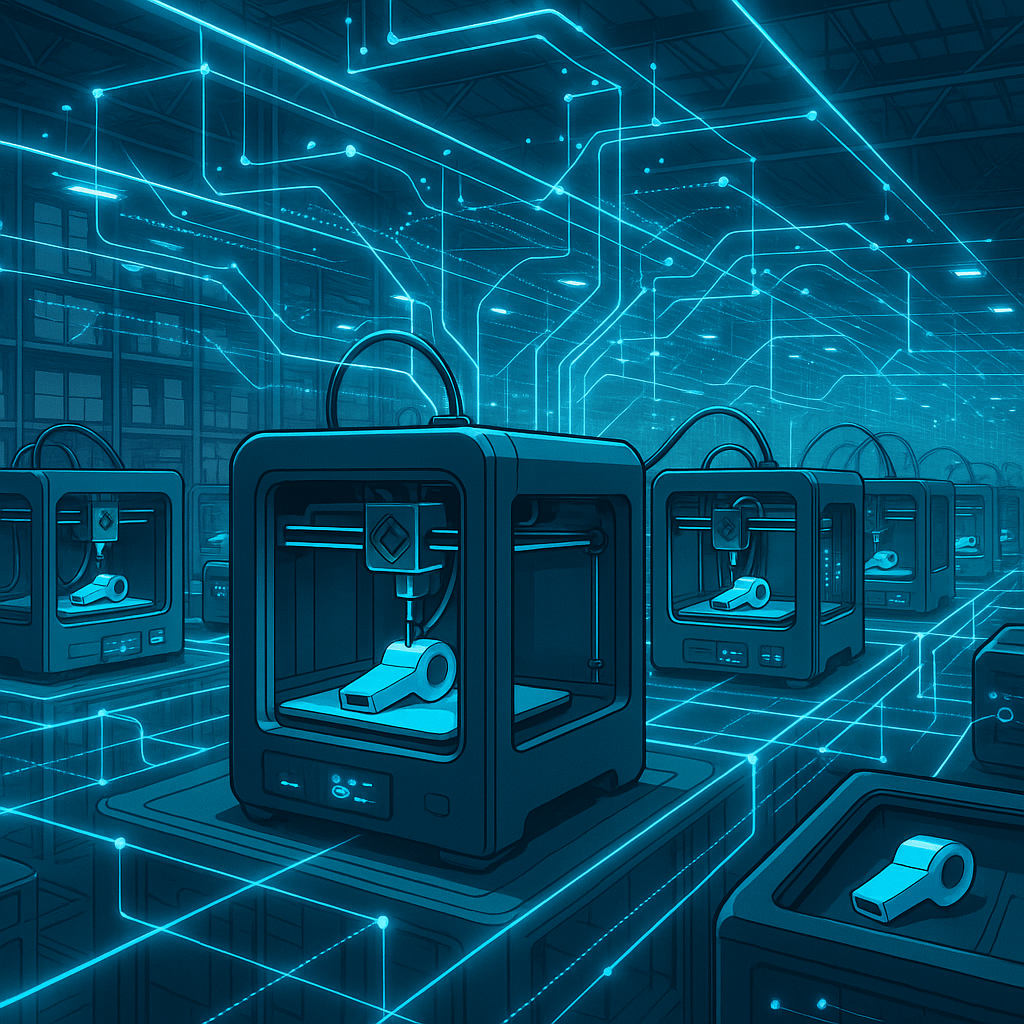
A recent US initiative has successfully established a 3D printed whistle distribution network that has moved over half a million units, according to VoxelMatters. This project leverages 3D printing technology to create and distribute whistles on-demand across a decentralized network, bypassing traditional centralized manufacturing and inventory models.
Why It Matters
This initiative is a practical demonstration of distributed manufacturing’s potential to reshape supply chains by enabling localized, on-demand production. By producing and distributing 500,000 units without relying on large-scale centralized factories or warehousing, the project highlights how digital inventory can reduce lead times, lower logistics costs, and improve responsiveness to demand fluctuations.
Such a model can be transformative for industries requiring rapid replenishment of small, standardized parts or products, especially in emergency services, sports, and education sectors where whistles are commonly used. It also serves as a proof of concept for broader applications of additive manufacturing in digital inventory management strategies.
Technical Context
The project utilizes 3D printing, likely fused deposition modeling (FDM) or selective laser sintering (SLS), to fabricate whistles. While exact technical specifications are not detailed, the scale of half a million units suggests a mature printing setup capable of high throughput and consistent quality.
Distributed manufacturing here means multiple print locations possibly coordinated through a centralized digital platform that manages orders, digital inventory files, and production schedules. This approach reduces dependency on physical stockpiles, allowing digital files to be transmitted and printed locally as needed.
However, details such as the geographic distribution of print nodes, materials used, print times, and quality control processes remain unknown. These factors critically influence scalability and cost-effectiveness.
Near-term Prediction Model
Within the next 12 to 18 months, we can expect similar distributed manufacturing initiatives to emerge for other standardized, low-complexity parts. The maturity of this model is currently at a pilot-to-commercial transition stage, with growing confidence in its viability but ongoing challenges in scaling and integration with existing supply chains.
Key drivers for adoption will include improvements in print speed, material costs, and digital platform sophistication. Meanwhile, regulatory and quality assurance frameworks will need to evolve to support decentralized production without compromising product standards.
What to Watch
- Expansion of distributed print networks beyond whistles to other small, high-demand items.
- Development of standardized digital inventory management platforms enabling seamless order routing and production coordination.
- Advances in multi-material and faster 3D printing technologies that can broaden product complexity and reduce costs.
- Regulatory adaptations addressing quality control and liability in distributed manufacturing.
- Case studies detailing cost-benefit analyses comparing traditional inventory models with digital on-demand approaches.
Overall, this US whistle distribution network is a significant step toward validating distributed manufacturing’s promise. It provides a tangible example of how digital inventory and on-demand production can be operationalized at scale, signaling a shift in how supply chains may be structured in the near future.