
What Happened
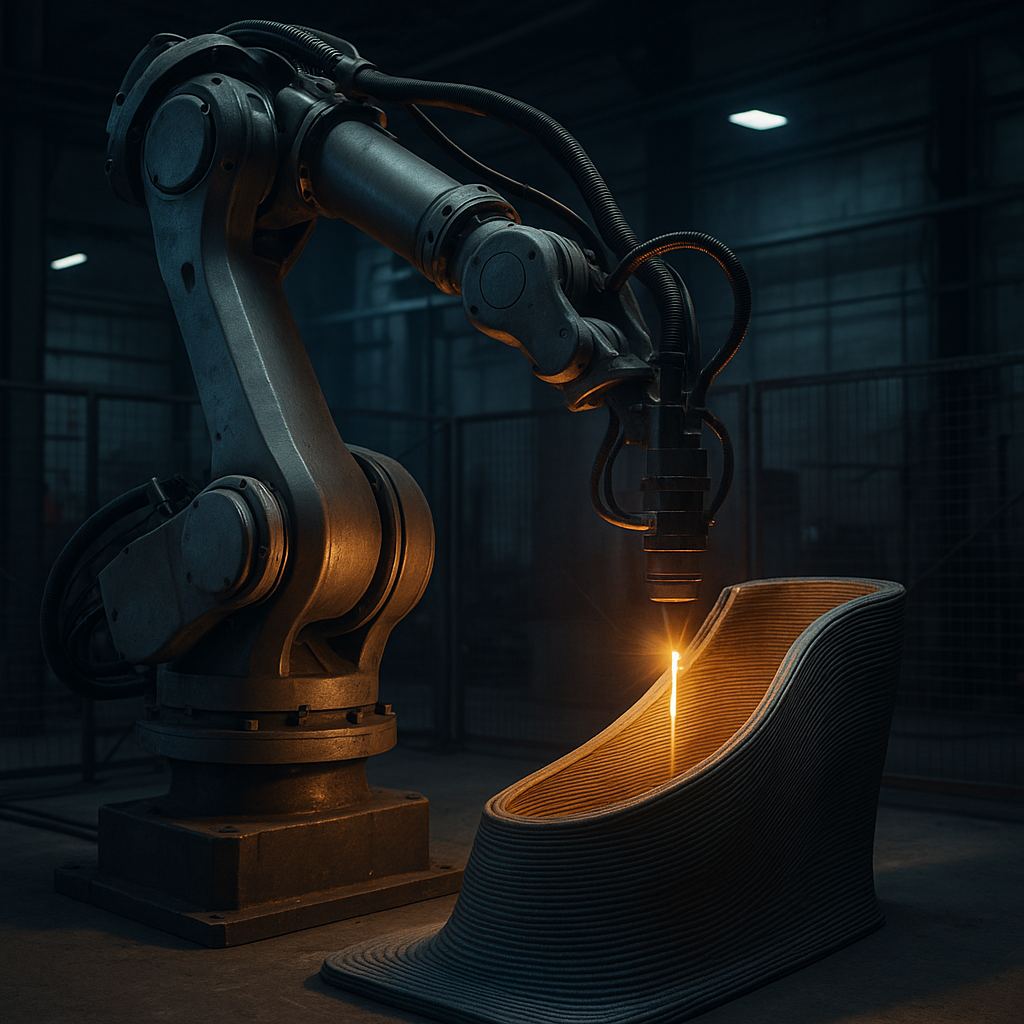
In a recent development spotlighted by 3DPrint.com, Haddy, a startup specializing in large-format robotic arm 3D printing services, has secured backing from the Disney Accelerator program. This endorsement highlights Haddy’s potential to revolutionize additive manufacturing by leveraging robotic arms for scalable, non-planar, and multi-axis printing solutions.
Why It Matters
The support from Disney Accelerator signals a growing industry interest in robotic arm 3D printing, particularly for large-format applications. Traditional 3D printing methods often rely on planar, layer-by-layer deposition which limits design complexity and size scalability. Haddy’s approach, using robotic arms, enables multi-axis printing that can deposit material along curved surfaces and complex geometries, thereby expanding design freedom and reducing the need for support structures.
This advancement is especially relevant for industries such as entertainment, automotive, aerospace, and architecture, where large, intricate components are common. The ability to print large parts with enhanced geometric complexity and structural integrity could reduce manufacturing lead times and costs, while enabling novel product designs.
Technical Context
Robotic arm 3D printing integrates industrial robotic manipulators with additive manufacturing heads to perform non-planar and multi-axis deposition. Unlike traditional gantry or delta printers, robotic arms offer six degrees of freedom, allowing the print head to approach the build surface from virtually any angle. This capability supports continuous material deposition on curved or angled surfaces, reducing the stair-step effect seen in planar layer printing and improving mechanical properties.
Large-format robotic printing also presents challenges such as precise motion control, calibration, and material handling at scale. The technology requires advanced software to generate toolpaths that optimize the multi-axis movements and maintain print quality. Material extrusion processes (e.g., fused filament fabrication or pellet extrusion) must be adapted for consistent flow and adhesion on non-horizontal surfaces. Haddy’s service likely addresses these challenges through proprietary hardware-software integration, though specific technical details remain undisclosed.
Near-Term Prediction Model
Within the next 12 to 24 months, we can expect Haddy to move from pilot demonstrations to early commercial deployments, especially in sectors where large, customized parts are valued. The Disney Accelerator backing may also facilitate partnerships in entertainment and themed environments, where bespoke large-scale objects are in demand.
As robotic arm 3D printing matures, adoption barriers such as cost, process reliability, and software complexity will gradually diminish. We anticipate incremental improvements in multi-material printing, print speed, and automation integration. However, widespread industrial adoption will depend on proving consistent quality at scale and demonstrating cost advantages over traditional manufacturing or planar 3D printing.
What to Watch
- Haddy’s commercial rollout: Monitor announcements of pilot projects, client partnerships, and case studies showcasing the application of their large-format robotic printing service.
- Software advancements: Observe innovations in multi-axis slicing and path planning software that enable efficient non-planar printing strategies.
- Material development: Track progress in materials optimized for robotic arm deposition, including composites and functional materials.
- Competitive landscape: Watch for other startups or established manufacturers entering the large-format robotic printing space, which could accelerate technology refinement.
- Industry adoption: Follow sectors such as entertainment, automotive, and aerospace for early adopters leveraging this technology to create complex, large-scale parts.
In summary, Haddy’s backing by Disney Accelerator underscores the growing momentum behind robotic arm 3D printing as a transformative approach to non-planar, multi-axis additive manufacturing. While technical and commercial challenges remain, the potential to unlock new design possibilities and efficiencies in large-format production marks this as a frontier technology worth close attention.