
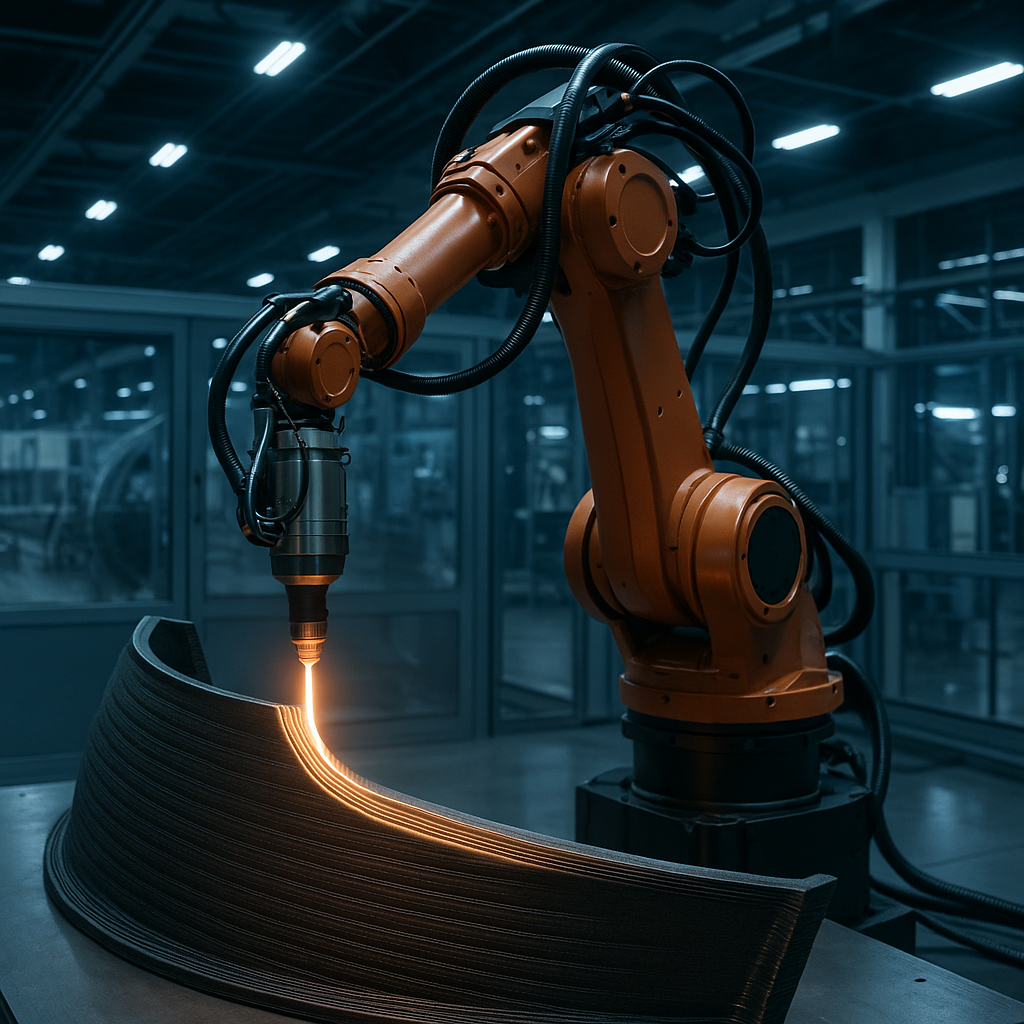
In a recent development detailed by FLYING Magazine, Airbus is actively experimenting with robotic arm 3D printing to fabricate aircraft parts. This initiative marks a significant step toward integrating non-planar and multi-axis additive manufacturing technologies in aerospace production.
What Happened
Airbus has begun trials using robotic arms equipped with 3D printing capabilities to produce components for aircraft. Unlike traditional planar 3D printing methods that build parts layer by layer on a flat surface, these robotic arms enable multi-axis, non-planar deposition paths. This allows for printing on complex geometries and curved surfaces, potentially reducing the need for assembly and post-processing. Details on the specific parts being printed, the materials used, and the scale of the trials remain limited in the public domain.
Why It Matters
The aerospace industry demands high-performance, lightweight, and structurally optimized components. Conventional manufacturing often involves multiple processes, including machining, assembly, and finishing, which increase cost and lead time. Robotic arm 3D printing offers the possibility to print large, complex parts in fewer steps, improving design freedom and reducing waste. This approach could significantly enhance production efficiency, part performance, and customization, directly impacting aircraft manufacturing economics and sustainability.
Technical Context
Traditional fused filament fabrication (FFF) and powder bed fusion (PBF) 3D printing methods are typically constrained to planar layers, limiting design complexity and often requiring support structures. Robotic arm 3D printing leverages multi-axis kinematics—usually 5 or 6 degrees of freedom—to deposit material along curved surfaces and complex orientations. This non-planar additive manufacturing reduces anisotropy in mechanical properties and allows for continuous fiber reinforcement along stress paths, which is critical in aerospace applications.
Materials compatible with robotic arm 3D printing in aerospace include advanced thermoplastics, thermoplastic composites, and metal wire or powder feedstocks. However, controlling process parameters such as temperature, deposition speed, and path accuracy is more challenging with multi-axis systems. Additionally, integrating in-situ monitoring and post-processing steps like heat treatment or surface finishing remains an area of active research.
Near-Term Prediction Model
Given the current information, Airbus’s robotic arm 3D printing efforts are in the pilot stage. Over the next 12 to 24 months, we can expect incremental improvements in process reliability and part qualification. The technology’s impact score is moderate to high (around 70 out of 100) due to its potential to disrupt traditional aerospace manufacturing. Confidence in successful integration depends on overcoming technical challenges related to material properties, process repeatability, and certification compliance.
What to Watch
- Advancements in multi-axis path planning algorithms that optimize print quality and structural performance.
- Material development tailored for robotic arm 3D printing, especially high-performance composites and aerospace-grade metals.
- Certification progress and regulatory acceptance for 3D printed parts manufactured via non-planar methods.
- Integration of real-time process monitoring and closed-loop control systems to ensure quality assurance.
- Collaborations between aerospace OEMs, robotics companies, and material suppliers to accelerate technology maturation.
In summary, Airbus’s exploration of robotic arm 3D printing represents a promising frontier in non-planar and multi-axis additive manufacturing. While many technical and regulatory hurdles remain, this approach could redefine how complex aerospace components are designed and produced, offering improved performance and manufacturing agility.