
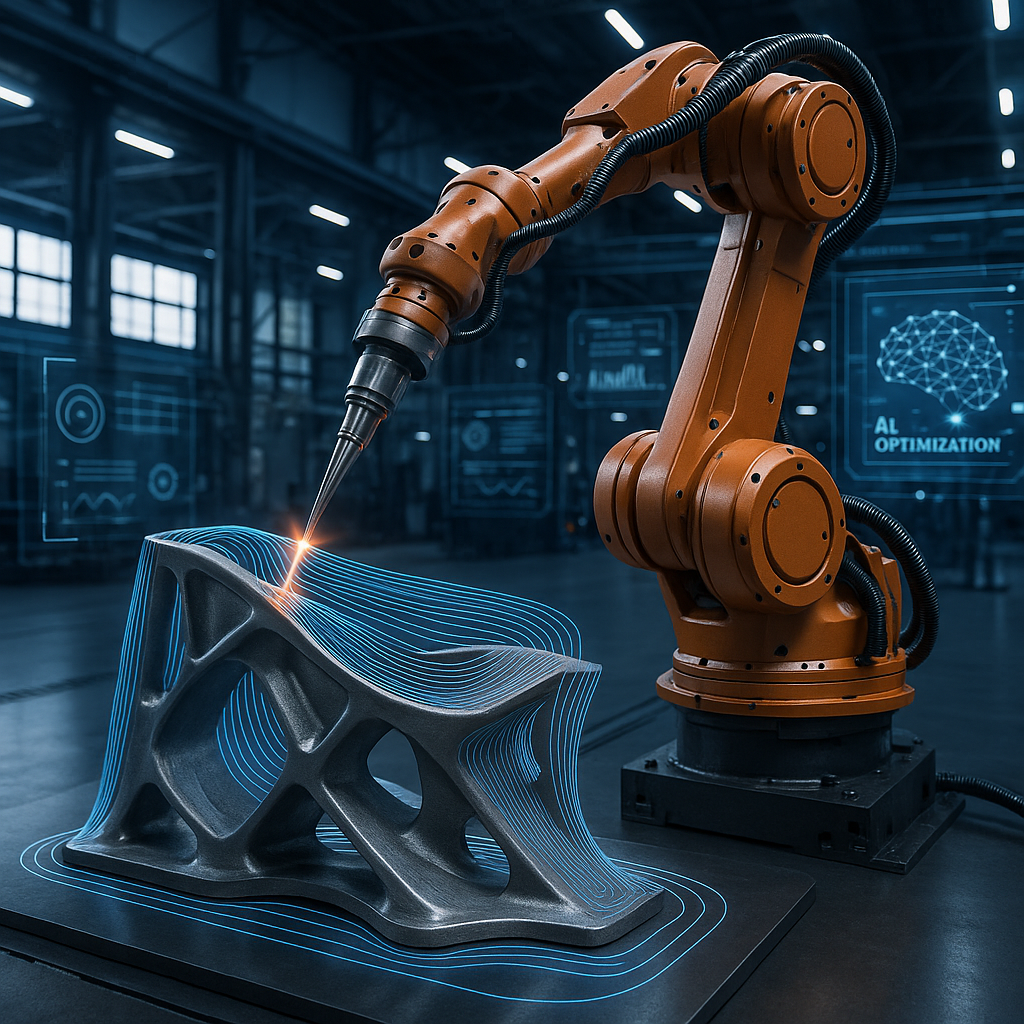
Recent calls for Europe to emulate China’s industrial 3D printing strategy, as reported by Nikkei Asia, highlight a pivotal shift in industrial additive manufacturing. Central to this transformation is the adoption of advanced robotic arm 3D printing technologies that enable non-planar and multi-axis printing capabilities. This article synthesizes the significance of this strategic push, its technical underpinnings, and what it means for the future of 3D printing in Europe and beyond.
What Happened
Europe has been urged to follow China’s lead in industrial 3D printing, specifically by embracing sophisticated multi-axis robotic arm 3D printing systems. China’s approach integrates robotic arms capable of printing along multiple axes, breaking free from traditional planar layer-by-layer methods. This enables more complex geometries, improved structural integrity, and faster production cycles. The push comes amid growing recognition that such technologies are critical to maintaining competitiveness in global manufacturing.
Why It Matters
The significance of this development lies in the fundamental shift from planar to non-planar 3D printing. Traditional 3D printing relies on fixed, single-axis layer deposition, which limits design freedom and can introduce weaknesses at layer interfaces. Multi-axis robotic arm systems allow for continuous, curved, and complex surface printing, enhancing mechanical properties and reducing post-processing needs.
For Europe, lagging in this domain risks losing ground in high-value manufacturing sectors such as aerospace, automotive, and medical devices, where customized, lightweight, and structurally optimized components are increasingly demanded. Adopting robotic arm 3D printing aligns with broader industrial digitization and automation trends, promising greater flexibility and efficiency.
Technical Context
Robotic arm 3D printing leverages industrial robotic manipulators equipped with extrusion or deposition tools capable of moving in six or more degrees of freedom. This multi-axis movement enables printing on complex surfaces and in orientations impossible for conventional gantry-style printers. The technology supports a variety of materials, including polymers, composites, and metals, depending on the toolhead integration.
Key technical challenges include precise motion control, real-time path planning to accommodate curved surfaces, and ensuring consistent material deposition across variable angles. Software advancements in slicing algorithms and simulation are critical to fully harnessing the potential of multi-axis printing.
China’s industrial strategy reportedly integrates these robotic systems with AI-driven process optimization and digital twins, further enhancing productivity and quality assurance. Details on Europe’s current capabilities and specific initiatives in this area remain limited, indicating a need for increased investment and collaboration.
Near-Term Prediction Model
Within the next 24 to 36 months, Europe is likely to accelerate pilot projects and commercial deployments of robotic arm 3D printing in targeted sectors. Early adoption will focus on aerospace and automotive components where complex geometries and material performance are paramount.
We anticipate a gradual shift from R&D to pilot and early commercial stages, supported by increased government and private sector funding. Integration with Industry 4.0 frameworks and supply chain digitization will enhance scalability.
However, widespread industrial adoption may still face hurdles related to standardization, certification, and workforce training. Overcoming these will be essential for realizing the full impact of multi-axis robotic arm 3D printing.
What to Watch
- European Union and national funding announcements targeting multi-axis additive manufacturing research and infrastructure.
- Collaborations between robotic arm manufacturers, software developers, and industrial end-users to create turnkey solutions.
- Advancements in slicing software and AI algorithms for non-planar toolpath generation.
- Standardization efforts and regulatory frameworks addressing quality assurance for multi-axis printed parts.
- Case studies demonstrating performance improvements and cost benefits in critical sectors like aerospace and healthcare.
In conclusion, Europe’s industrial 3D printing future hinges on embracing robotic arm multi-axis technology. While China currently leads with a cohesive strategy, Europe has the opportunity to leverage its strong manufacturing base and innovation ecosystem to close the gap. Monitoring developments in this space will be crucial for stakeholders aiming to capitalize on next-generation additive manufacturing capabilities.