
What Happened
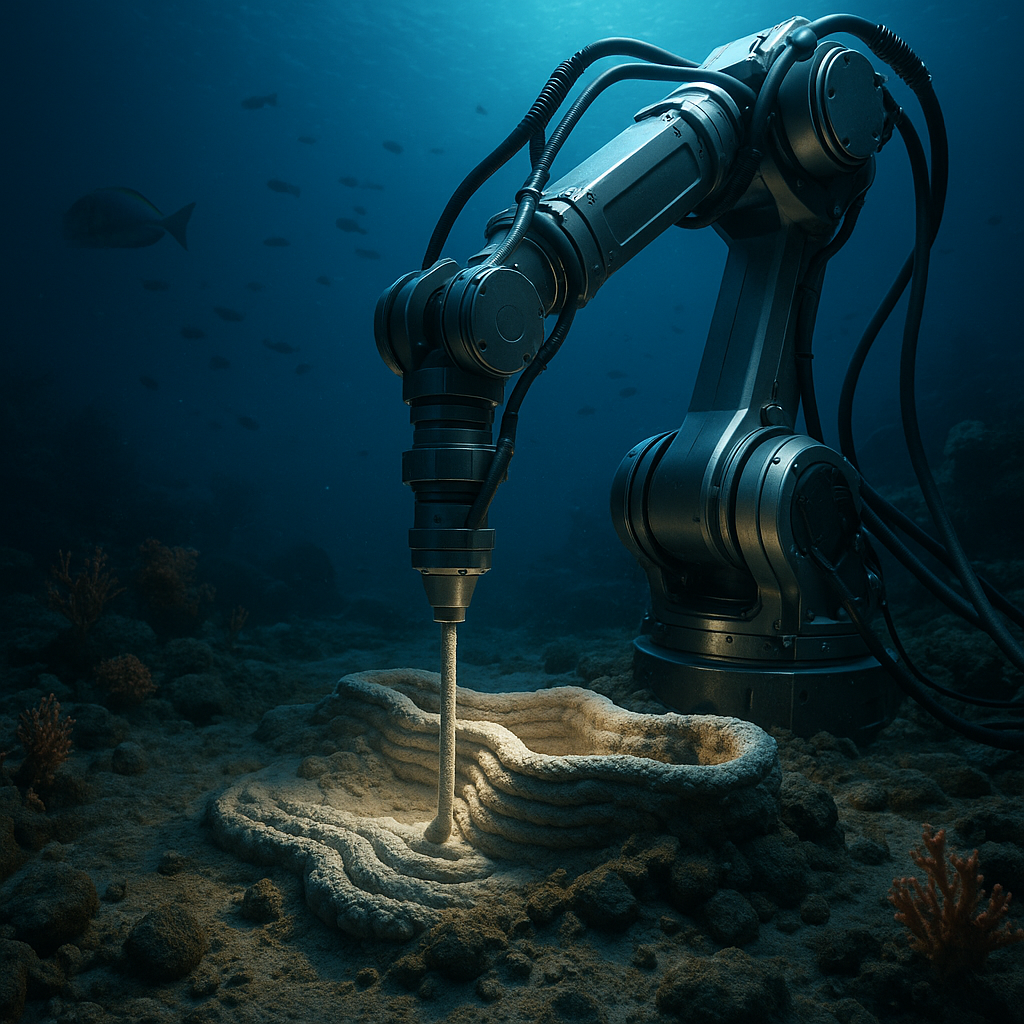
Recent developments in 3D printing technology have enabled the fabrication of concrete structures underwater by utilizing seafloor sediment as a raw material. A report from AZoBuild highlights this pioneering approach, which leverages robotic arm 3D printing techniques to deposit concrete underwater with precision and adaptability. This marks a significant leap in the application of multi-axis, non-planar 3D printing for challenging environments.
Why It Matters
Underwater construction is traditionally fraught with logistical challenges, high costs, and environmental concerns. The ability to 3D print concrete directly on the seafloor using locally sourced sediment could revolutionize subsea infrastructure development, such as underwater pipelines, marine habitats, and offshore platforms. This approach minimizes the need for transporting heavy materials and reduces environmental disturbance by utilizing in-situ resources. Moreover, robotic arm 3D printing offers multi-axis motion freedom, enabling complex geometries that conform to uneven underwater surfaces, which is difficult to achieve with conventional planar printing methods.
Technical Context
Robotic arm 3D printing represents an advanced form of additive manufacturing that transcends traditional layer-by-layer planar deposition. By employing multi-axis kinematics, these systems can deposit material along curved, angled, and intricate paths, which is crucial for adapting to the irregular topography of the seafloor. The integration of seafloor sediment into the concrete mix introduces unique challenges such as controlling sediment composition, particle size distribution, and ensuring structural integrity underwater. The printing process must also account for fluid dynamics and sediment interaction to maintain precise material placement and curing.
Current implementations likely involve custom robotic arms equipped with specialized extrusion nozzles capable of handling cementitious mixtures underwater. Sensors and feedback systems may be employed to adjust deposition in real-time, compensating for underwater currents and substrate variability. However, detailed technical parameters such as sediment processing methods, binder formulations, and robotic control algorithms remain undisclosed in the public domain.
Near-Term Prediction Model
This technology is currently in the Pilot stage, with active demonstrations of underwater concrete printing using seafloor sediment. Over the next 12 to 24 months, we anticipate incremental improvements in material formulations and robotic control precision, enabling larger-scale and more complex underwater structures. The impact score is estimated at 75 out of 100, reflecting significant potential disruption in subsea construction and environmental engineering.
Confidence in this prediction stands at 70 due to the nascent state of the technology and limited publicly available data. Key risks include material durability under prolonged underwater conditions, robotic system reliability in harsh marine environments, and regulatory hurdles related to underwater construction and environmental protection.
What to Watch
- Advancements in sediment processing and binder chemistry tailored for underwater 3D printing.
- Development of robust multi-axis robotic arms with enhanced underwater operational capabilities.
- Field trials demonstrating structural performance and environmental impact assessments.
- Integration of real-time sensing and adaptive control systems to improve print accuracy in dynamic underwater conditions.
- Regulatory developments governing underwater additive manufacturing and marine ecosystem protection.